
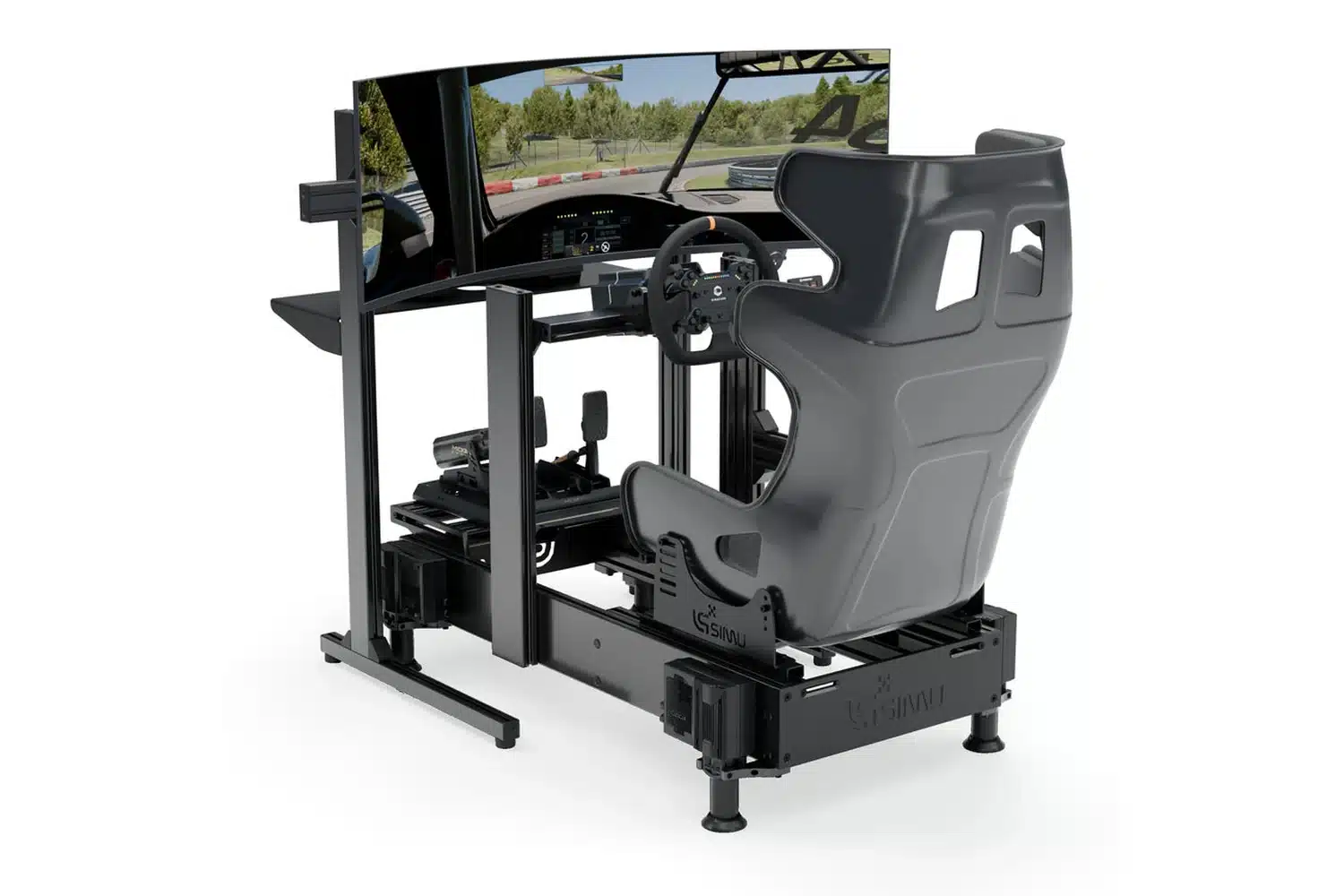

#1: Dynamic GT
⭐ Rating: 9.8/10
✅ The complete simulator—no compromises
We love it for its D-BOX drive system and its 25 Nm torque.
#2: GT with three screens
⭐ Rating: 9.7/10
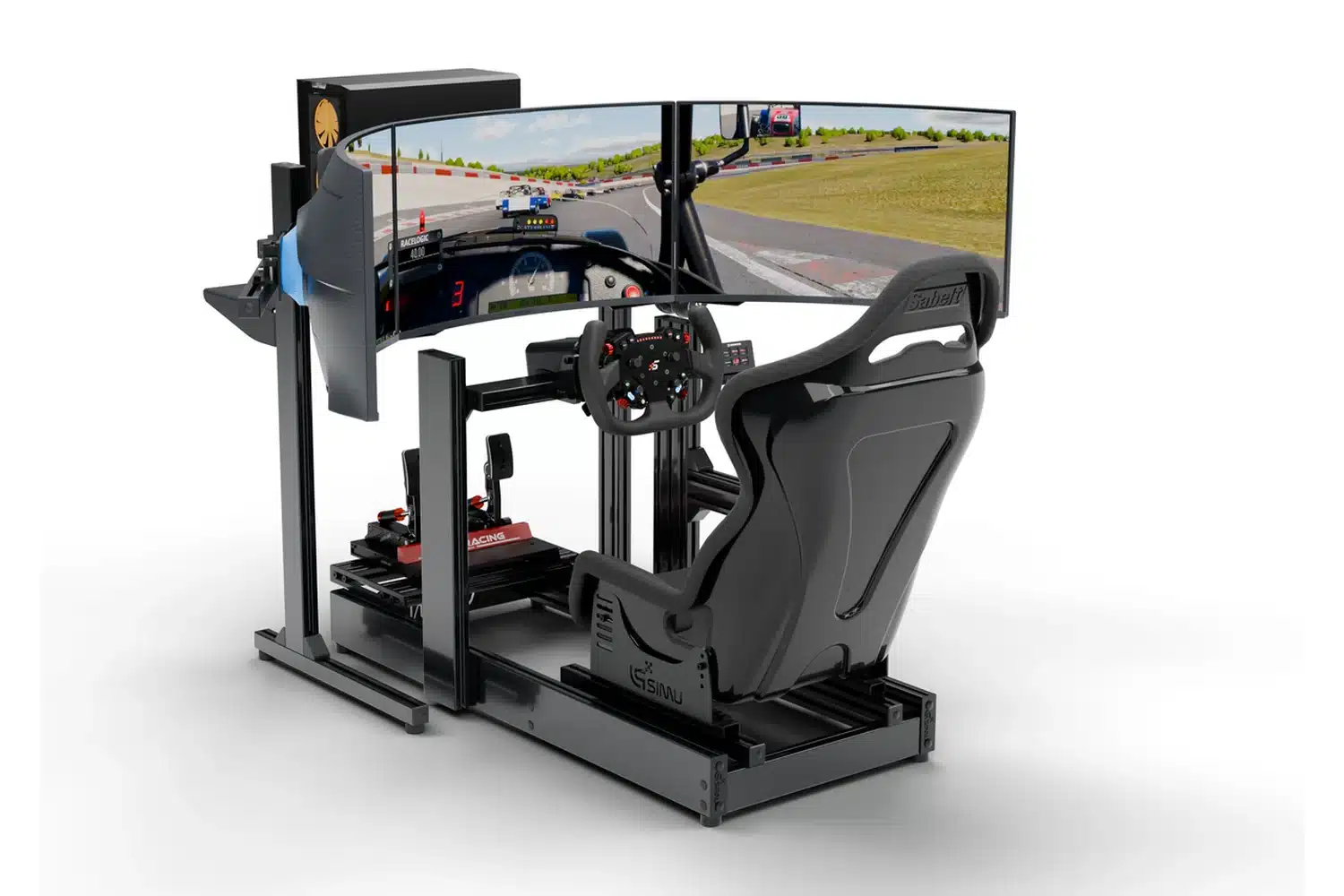
✅ The best value for money
We love it for its triple screen and its 12 Nm Simagic base.
#3: Triple-Screen Rally
⭐ Score : 9.6/10
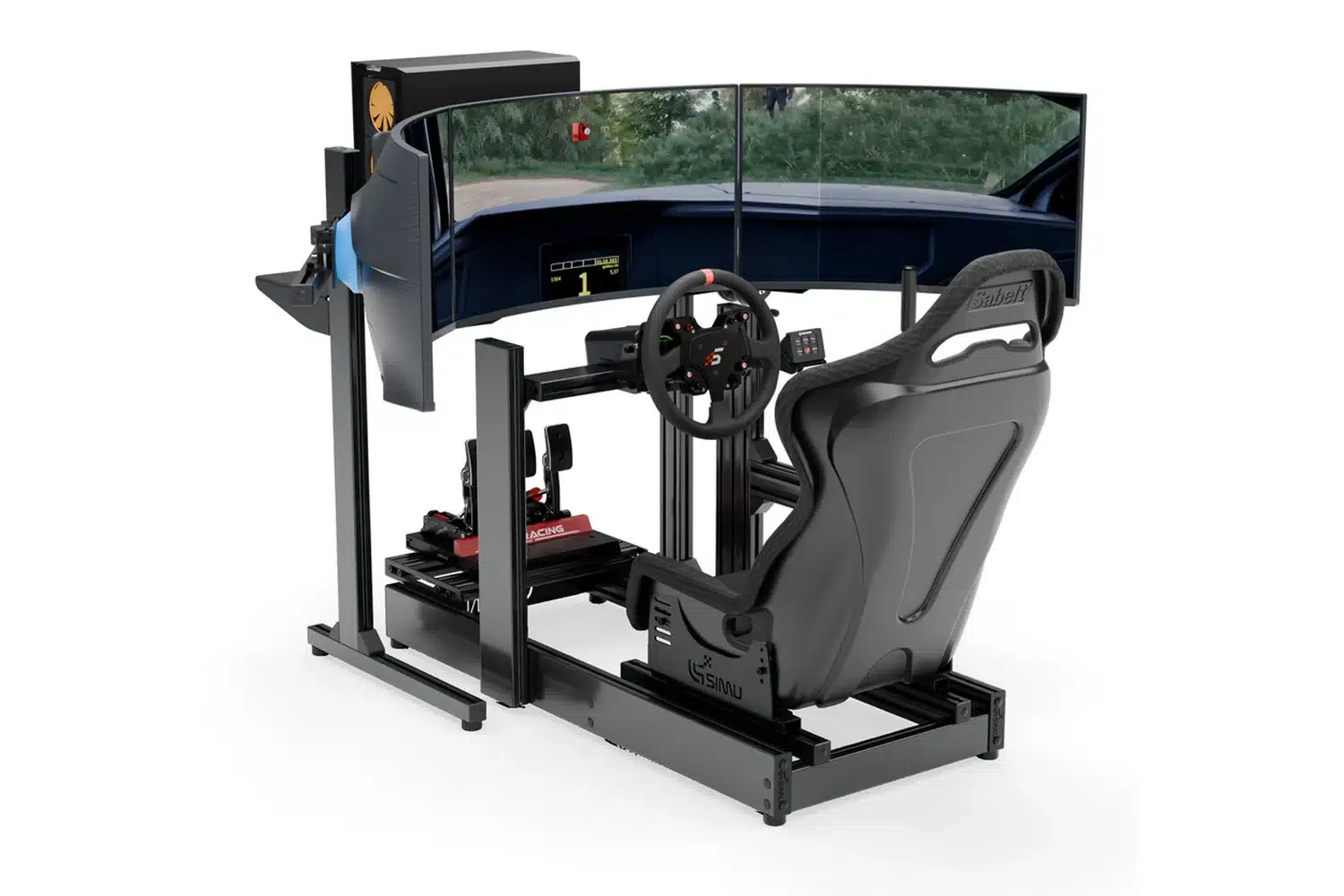
✅ The best choice for rally racing
We love it for its H-shaped gearshift and hydraulic parking brake.
Sim-racing is all about sensations and immersion. The more your brain thinks it’s in the cockpit of a racing car, the better the immersion. Nowadays, simulation equipment such as Direct Drive bases, pedals and other steering wheels are no longer enough. Drivers need something extra to make them feel as comfortable as if they were in the cockpit of a racing car.
Chassis are a significant plus for setup, as they allow for immersion, especially if it’s a tubular. Seeing the tubular steel structure surrounding you, it’s as if you were actually in the cockpit of a Supercar, with the roll cage all around you.
But there’s a catch. Assembling a chassis is no mean feat. Tubular frames are easier to assemble than aluminum ones, but there are limits to their customizability. Basically, if the manufacturer doesn’t offer this or that support, there’s nothing you can do about it (I’m talking about tubular chassis).
But luckily for us, some shops deliver the complete simulator, already assembled and calibrated—that is, with all the equipment needed for racing: chassis, bucket seat, Direct Drive base, steering wheel, pedal set, monitor, and PC. The four simulators I’ve selected are among these: three for track racing and one for rally racing, all from the workshop of a manufacturer partnered with the site, which assembles and calibrates them before delivery. Let’s take a closer look at them.
#1 The Dynamic GT Simulator
Let’s start right off with the big daddy of this list: the dynamic GT simulator. Simply put, it’s a full GT setup to which the workshop adds a D-BOX GEN5 motion system. The actuators move the cockpit based on the game’s telemetry: braking, speed bumps, and changes in road surface are also felt through the seat—not just the steering wheel.
In terms of equipment, the setup includes a 25 Nm Simucube 2 Pro with the Simucube Valo GT-23 steering wheel, the MOZA mBooster active pedal set—which allows for adjustment of resistance and brake feel—and a 57-inch curved Samsung Dual UHD monitor. The Sabelt GT-PAD bucket seat is mounted on a rail, and the PC (Core i5-14400F, RTX 5070) comes with SimHub, Assetto Corsa, a Stream Deck Mini, a wireless headset, and a keyboard.
The only downside, in my opinion: an RTX 5070 for a 7,680 × 2,160-pixel display is barely sufficient for the most demanding simulations; you’ll need to lower some graphics settings. This is something to address in the quote. As for the price, expect to pay around €24,000, not including shipping and installation. That’s the cost of the motion system: the same setup without the D-BOX comes in under €15,000. But as they say: you can’t put a price on passion.
#2 The Triple-Screen GT Simulator
The triple-screen GT simulator ranks second in our top 4 list of the best all-around racing simulators, and it’s the one I’d recommend to the widest audience. Its unique feature is right in its name: three 32-inch curved Samsung Odyssey G5 monitors, with QHD resolution and refresh rates up to 165 Hz, that surround the driver. On the track, this side view is extremely helpful for positioning a car side-by-side or preparing for a apex.
For the peripherals, the workshop chose the Simagic ecosystem: a 12 Nm Simagic Alpha EVO Direct Drive base, the GTC steering wheel, and a P1000-F two-pedal set with a load cell brake. 12 Nm is enough to feel load transfers without pushing the base to its limits. The Sabelt SRS bucket seat is mounted on a rail, and it features the same PC and accessories as the dynamic simulator (Core i5-14400F, RTX 5070, Stream Deck Mini, wireless headset).
The real trade-off is the lack of a clutch. If you insist on driving a manual transmission with three pedals, there’s a version available with a 12 Nm MOZA R12 base unit, a CRP2 pedal set with a clutch, and a 49-inch screen—all for under €9,000. As for the price, the triple-screen GT simulator costs nearly €11,000, not including delivery and installation. It’s a bit pricey, yes, but it’s fully equipped and high-performance.
#3 The Triple-Screen Rally Simulator
Rally driving is a different way of driving, and this simulator is designed for that. We’re keeping the triple 32-inch screen, which helps you read a special stage and anticipate hairpin turns, but the controls have changed: a Simagic DS-8X shifter, which switches from an H-pattern to sequential mode, and a Simagic TB-RS hydraulic handbrake to position the car in tight corners.
As for the rest, it features the Simagic Alpha EVO base (12 Nm), this time paired with the Simagic GT1-SR steering wheel and a Simagic P1000 three-pedal set, including a clutch, which comes in handy with the H-pattern gearshift. The Sabelt SRS bucket seat and the PC (Core i5-14400F, RTX 5070) are the same as those on the triple-screen GT simulator.
If you want to try rally racing on a tighter budget, the workshop also offers a simpler version, featuring a 49-inch screen, a MOZA R9 V3 base, a sequential shifter, and a MOZA handbrake, for just over 7,000 €. As for the price, the triple-screen rally simulator costs around €12,000, not including shipping and installation.
#4 The GT Simulator for Beginners
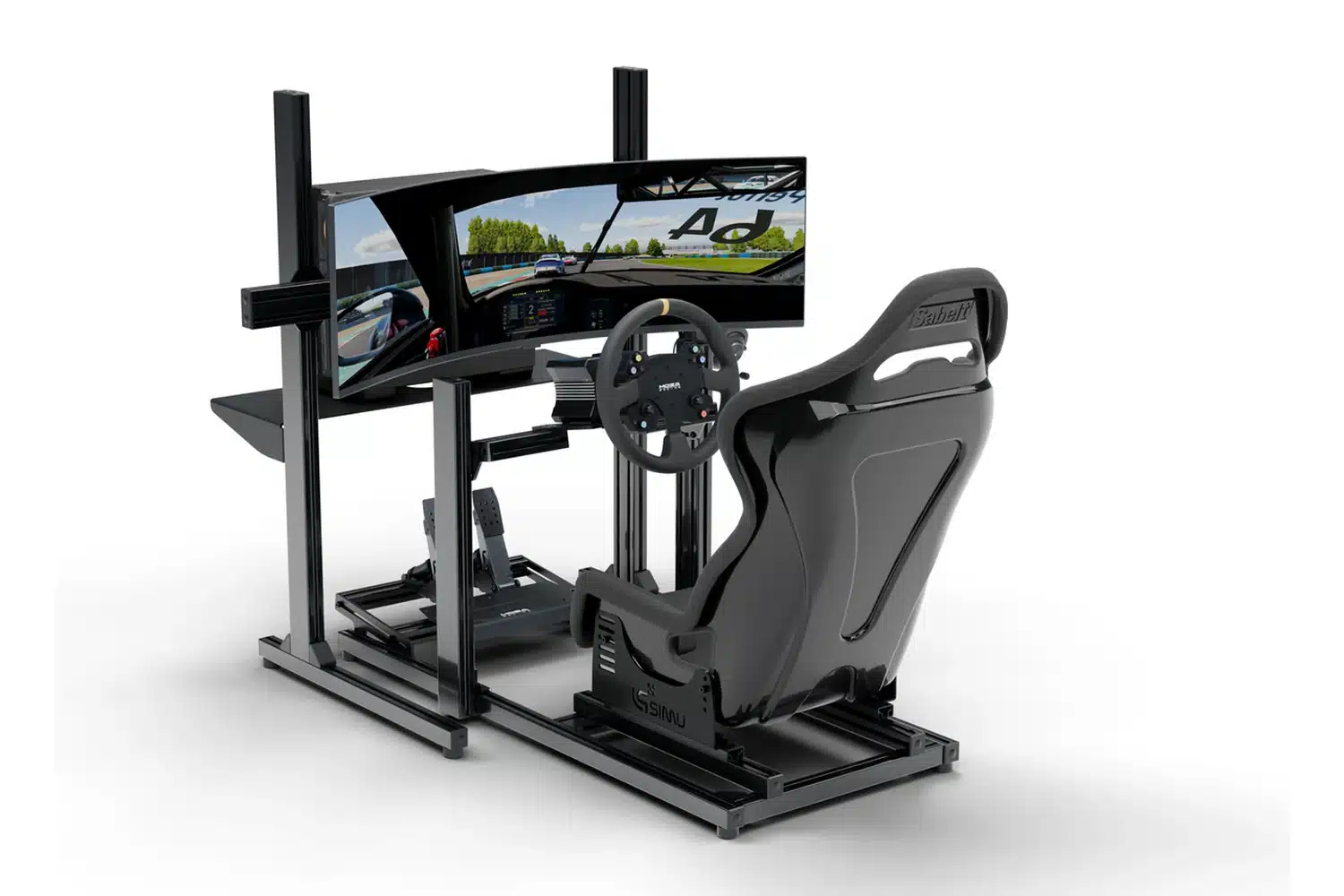
Let’s wrap up with the “budget-friendly” option, even though we know full well that this rarely applies to immersive sim racing. The GT simulator for beginners is the workshop’s entry-level GT model, but it’s definitely a full-featured simulator: adjustable chassis, Sabelt SRS bucket seat on rails and stainless steel slides, a 49-inch curved Samsung Odyssey G91F monitor (5,120 × 1,440 pixels, 144 Hz), and a PC with a Core i5-12600KF and RTX 5060.
For driving, the setup includes a 9 Nm MOZA R9 V3 base with the MOZA CS V2P steering wheel and a MOZA SR-P two-pedal set, featuring a load cell-based brake. 9 Nm is a good starting point for exploring Direct Drive and learning to sense when traction is lost.
Of course, at this price, there are some trade-offs: just one screen and a more modest power output than on the other models. But everything is included, assembled, and set up, and the frame leaves room to upgrade the system later. Price-wise, it sells for less than €7,000, not including shipping or installation.
Which one to choose?
Choosing between these four simulators may not seem easy, but it actually is: it all comes down to your discipline, your budget, and the level of immersion you’re looking for. If you’re just starting out or your budget is on the tight side, the entry-level GT simulator is the right place to start. If you already race regularly in GT or endurance events, go for the triple-screen GT simulator. Personally, that’s the one I’d go with: for €4,000 more than the entry-level version, the triple-screen setup really changes how you perceive the track, and the 12 Nm base gives you plenty of room to grow.
If you prefer special stages to racetracks, the triple-screen rally simulator is the only one of the four to feature an H-pattern shifter, a hydraulic parking brake, and a clutch—this is the one for you.
And if money isn’t an issue, and you have the experience and—above all—the goal of constantly improving your sim-racing skills, then the dynamic GT simulator is the way to go: 25 Nm, active braking, and D-BOX motion—it has everything you need.
The same workshop also offers drift simulators (around €8,000), a model for young drivers (just over €6,000), and a high-end F1 simulator, priced at around €40,000. And for projects that fall outside these parameters, it also builds fully custom simulators.
To receive a free quote for one of these simulators, including delivery and installation, click the button below: your request will be forwarded to our partner, the manufacturer of these simulators, who will contact you.
Request a free quote
Request sent
Thank you, your request has been sent. Our partner will contact you to prepare your quote.
0 Comments