
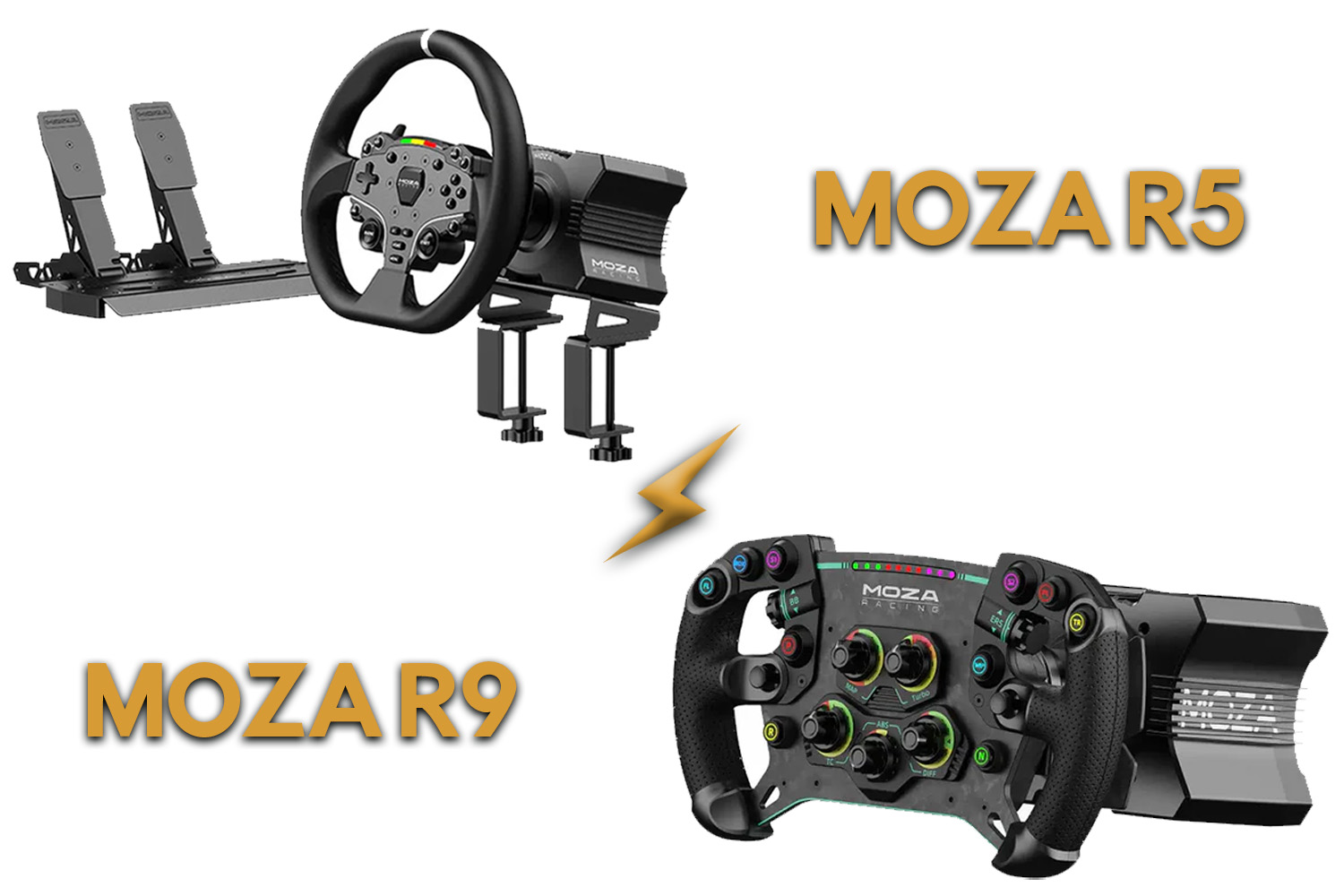

Today, Moza is a very convincing sim-racing option, compared with what’s available on the world market. Compared to other manufacturers of sim-racing peripherals, Moza Racing’s range is complete, varied and, above all, aggressively priced.
The brand’s Direct Drive bases include the R5 and R9. They cover two types of sim-racing drivers, who are among those looking for DD bases developing less than 10 nm of maximum torque.
For the R5, maximum power is 5.5 nm of torque, while the R9 tops out at 9 nm of torque, as its name suggests. On paper, there’s a noticeable difference in terms of power, but what about on track? Well, that’s what we’re going to look at now, and above all we’re going to try and answer the question of which base to choose between the R5 and the R9.
Base design and build quality
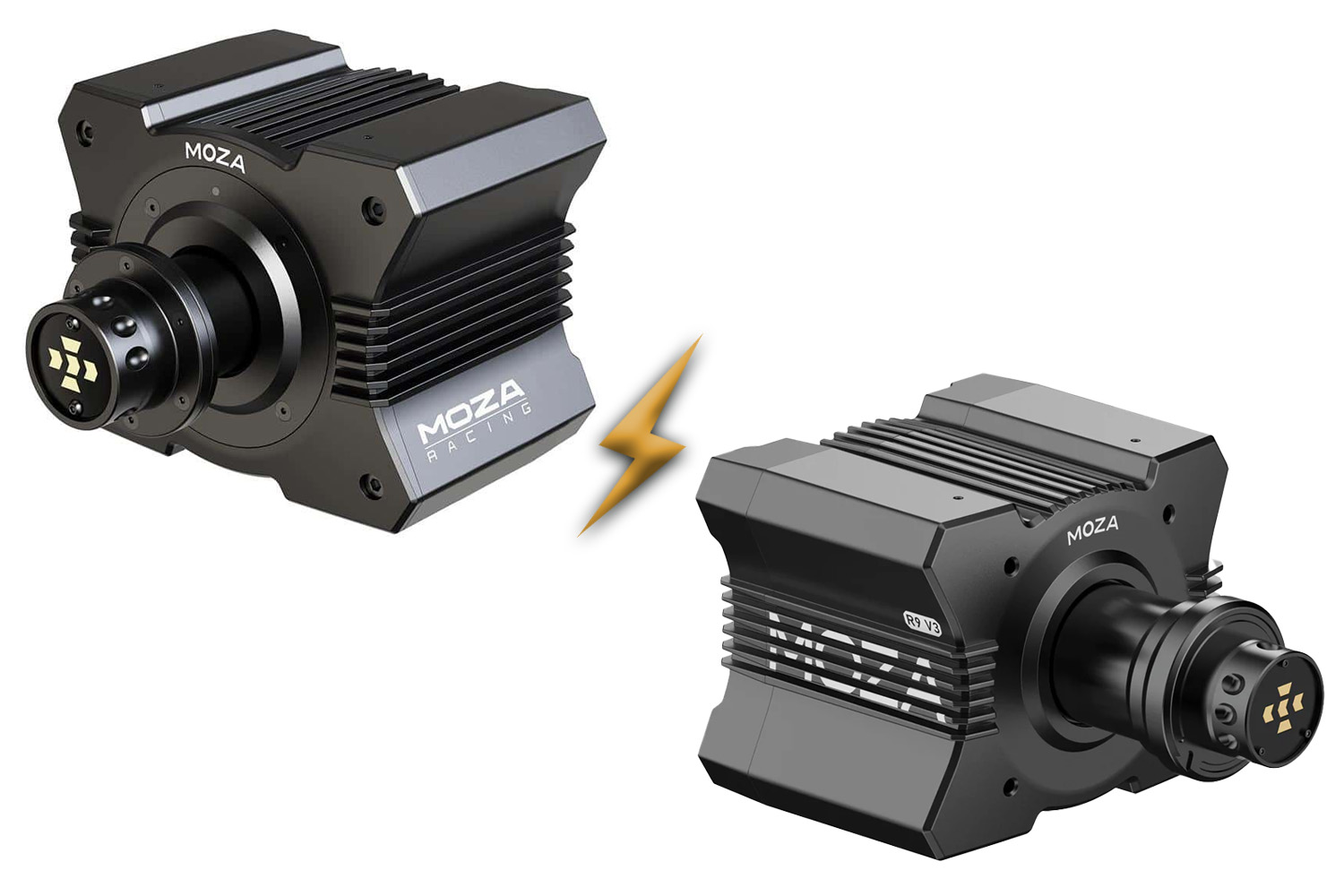
Let’s start with the design of the two bases. Broadly speaking, the R5 and R9 are very similar, with an “X” shape, a few fins on the sides and Moza logos on the casing.
The only notable difference between the two devices is the length of the driveshaft, and the placement of the logos. On the R5, the driveshaft is short, and on the R9 it’s longer. Why? Well, I guess they needed more space for the motor and electronics, without affecting the size of the housing. The two bases are therefore very compact, and share the same black color.
As far as build quality is concerned, it’s well done for both devices. Even if the R5 is technically part of Moza’s budget-friendly range, i.e. low-cost peripherals, the quality is still there. The R9 is a step up, as it’s aimed at an audience with more sim-racing experience. This point is reflected in both devices, as the R5 is only available for purchase as a bundle, whereas you can buy the R9 on its own and as a bundle.
Customized assembly
The similarity between the two bases also extends to their mounting on sim-racing setups, as they share the same fastening system. You obviously have a clamp that is compatible with the R5 and R9 to mount them on furniture. On top of that, you have the option of attaching them to cockpits from below. This is very versatile as far as I’m concerned, as the clamp is perfectly capable of taking the torque of both bases, without bending the latter.
Platform compatibility
Moza Racing is a young brand in sim-racing, and this is reflected in the platform compatibility of its bases. The R5 and R9 only work on PC, under Windows. Unfortunately, only the R3 bundle is supported by Xbox, but the base only develops 3.9 nm of torque, and that’s not enough if you’re looking for a device capable of delivering good sensations on the track.
As far as sim-racing titles are concerned, there’s no limit as far as I know, and you won’t have any problems with them. Moza’s software is complete, allowing you to set both bases according to sim-racing titles and disciplines. Note that you’ll need a little time to find the right settings, whether on the R5 or the R9.
Bundle availability
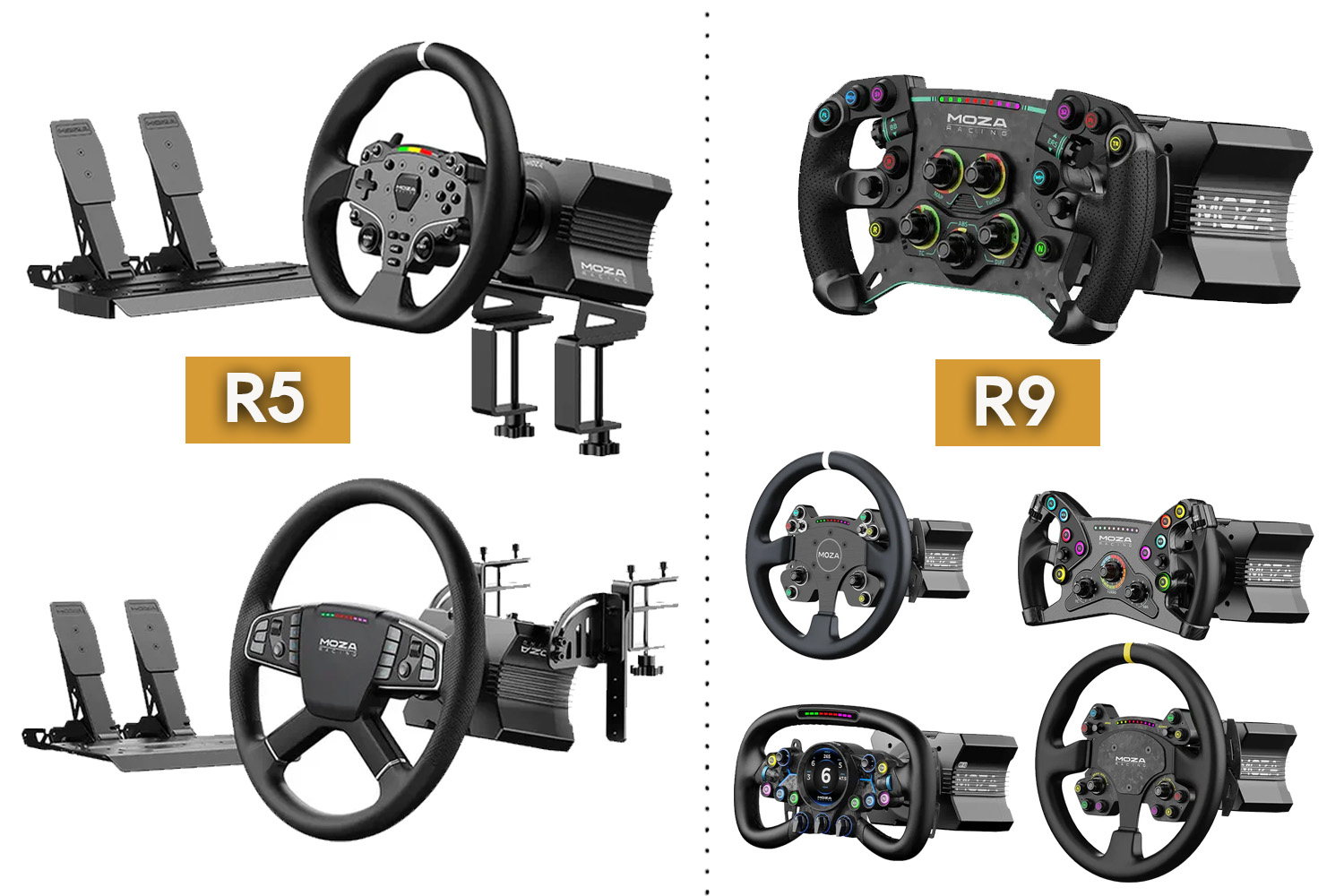
As I said above, you can buy the R9 on its own, or as a bundle. If you go the bundle route, Moza offers 6 bundles on its store. Please note that R9 bundles don’t come with a pedalboard, so you’ll need to plan for that when you buy.
When it comes to steering wheels, the R9s have a bit of everything, with GT, touring, Formula and even proto wheels. I think that’s enough for someone who wants to navigate in race simulation.
Let’s move on to the R5. At present, this base is only available as a bundle, with a single sim-racing steering wheel and another truck sim. It’s not much, but at least the R5 bundle comes with the SR-P Lite crankset. It’s not Load Cell, mind you, but the performance kit isn’t expensive, so it’s okay. What’s more, the R5 base incorporates Moza’s QR, giving you the option of installing all the brand’s steering wheels.
Sensation on the track
Let’s talk about the sensations obtained on Moza Racing’s R5 and R9. Let’s start with the small base, the R5. Technically, this device is the entry ticket to the Moza ecosystem, and so is sim-racing. I say technically, because the brand offers the R3 bundle, aimed primarily at Xbox racers.
As far as feedback is concerned, there’s a big difference in the effects felt if you’re coming from a belt-driven or gear-driven base. The details are there, and you can feel everything the car does: vibrators, bumps, shocks, bumps, changes in support, etc. You can feel all the forces the car undergoes, but there’s a limit. You can feel all the forces the car undergoes, but there’s a limit, and you quickly hit the clipping door if you push the base to its limits. Once maximum torque is reached, the base loses communication and becomes blurred as to the effects transmitted to the steering wheel. This is a problem inherent to all DD bases, and on one that develops 5.5 nm of maximum torque, you’ll quickly feel it on a simulation track.
When it comes to details, the R9 is just as loquacious as the R5: you’ll feel everything on your steering wheel, whether it’s the effects produced by the car or by the circuit. But where the difference between the two comes into its own is power: the R9 will pull longer before clipping. In other words, you’ll feel a lot more effect on track, where the R5 is already saturated.
The 9 nm of torque allow you to push the base even further, without any blurring at the wheel. The result is more feedback, lighter and heavier effects, and above all a much richer driving experience on the R9.
Value for money
The price/performance ratio of the two bases is slightly unbalanced for a simple reason: the R9 is available both as a base alone and as a bundle, while the R5 can only be purchased as a bundle. What’s more, the R5 bundle comes with steering wheel and pedals, while the R9 offers only the steering wheel.
Nevertheless, let’s talk about prices. The R5 retails for €479, and the R9 with the CS V2P steering wheel is €678. Moza bundles are often reduced in price, and you can have the R5 for €419 and the R9 with the same steering wheel for €579.
But if you want to buy the R9 base on its own, it costs €399. As far as I’m concerned, both bases are well placed against the competition, even if technically you can’t buy the R5 on its own.
They use quality materials, are well made for the price, and feel great.
Which one to choose?
Now it’s time to address the question you’re probably asking yourself: should you opt for the R5 bundle and save money, or is it better to take the plunge and go straight for the R9?
It’s a tricky question that basically involves three elements. The first is your level of sim-racing. The second is what you’re looking for in terms of sim-racing. And the third is your budget.
And to help you make your choice, here’s how I see it: if you’re new to sim-racing and have a limited budget, then get the R5. It’s a base that communicates the sim-racing title’s information well, and you’ll have plenty to do for a while. What’s more, it comes with a steering wheel and pedals.
But if you’re looking for a future-proof base, then the R9 is clearly the durable choice, especially if you can afford it. The big advantage of the R9 over the R5 is its power; you can limit the maximum torque of the R9 to match your sim-racing level, whereas the R5 won’t be able to produce more than 5.5 nm of torque.
0 Comments