
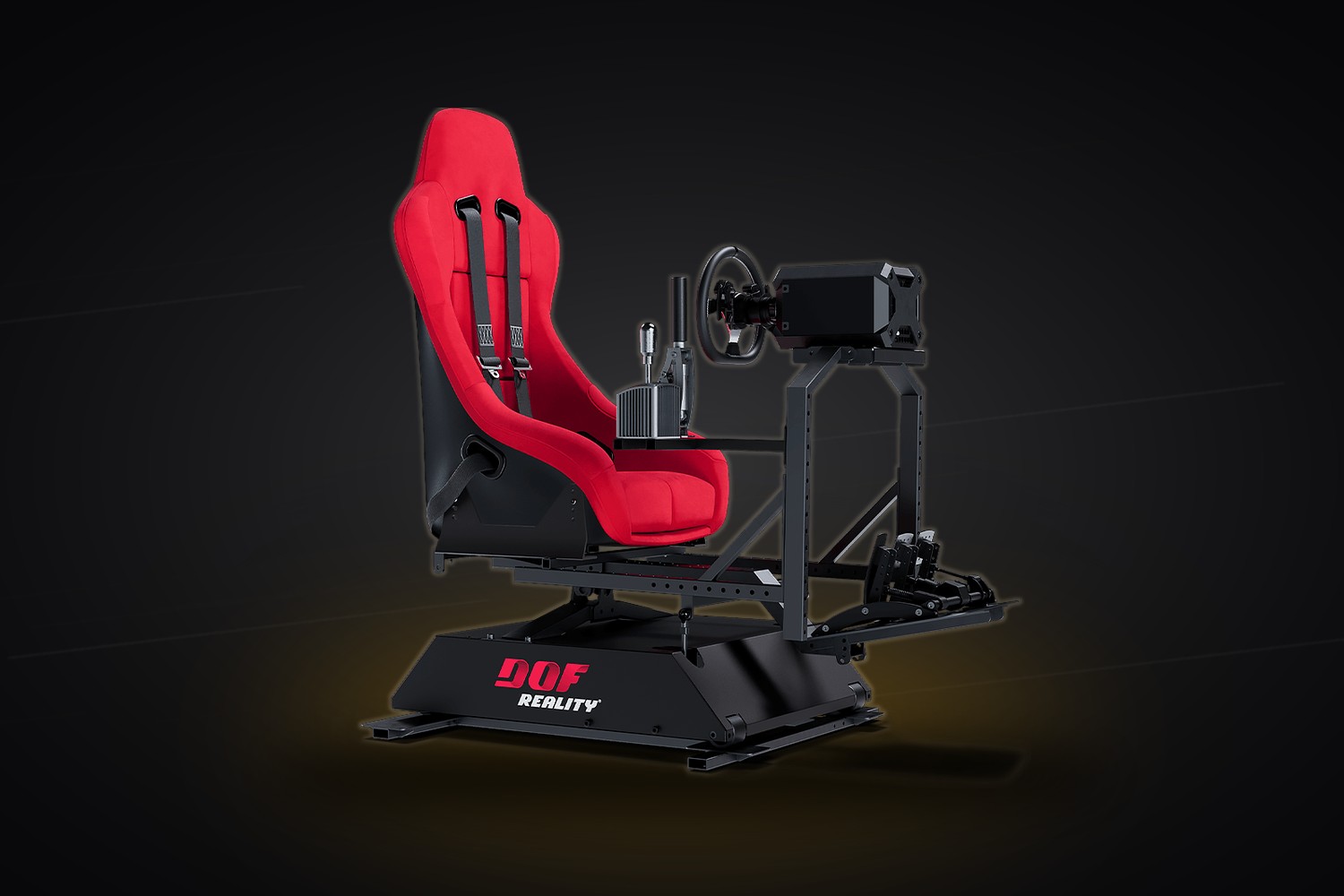

Getting a hyper-realistic driving experience while sitting in your bedroom might sound like a stretch. But today it’s much easier than it looks, thanks to motion simulators built for driving.
We’ve had the chance to take a close look at several of the most reputable rigs on the market, so today we’re presenting our pick of the best motion simulator models. In this article, we’ll also go over what a motion simulator is, which types you can find on the market and how to choose the right model.
#1: DOF Reality H3
⭐ Rating: 9.7/10
✅ The most polished complete platform
“Seat, wheel and pedals move together, just like the real thing.”
#2: DOF Reality M2
⭐ Rating: 9.6/10
✅ The best budget pick
“Motion under your seat, without swapping your cockpit.”
#3: MOZA HMA150
⭐ Rating: 9.5/10
✅ The next-generation actuator kit
“Four actuators that genuinely move your cockpit.”
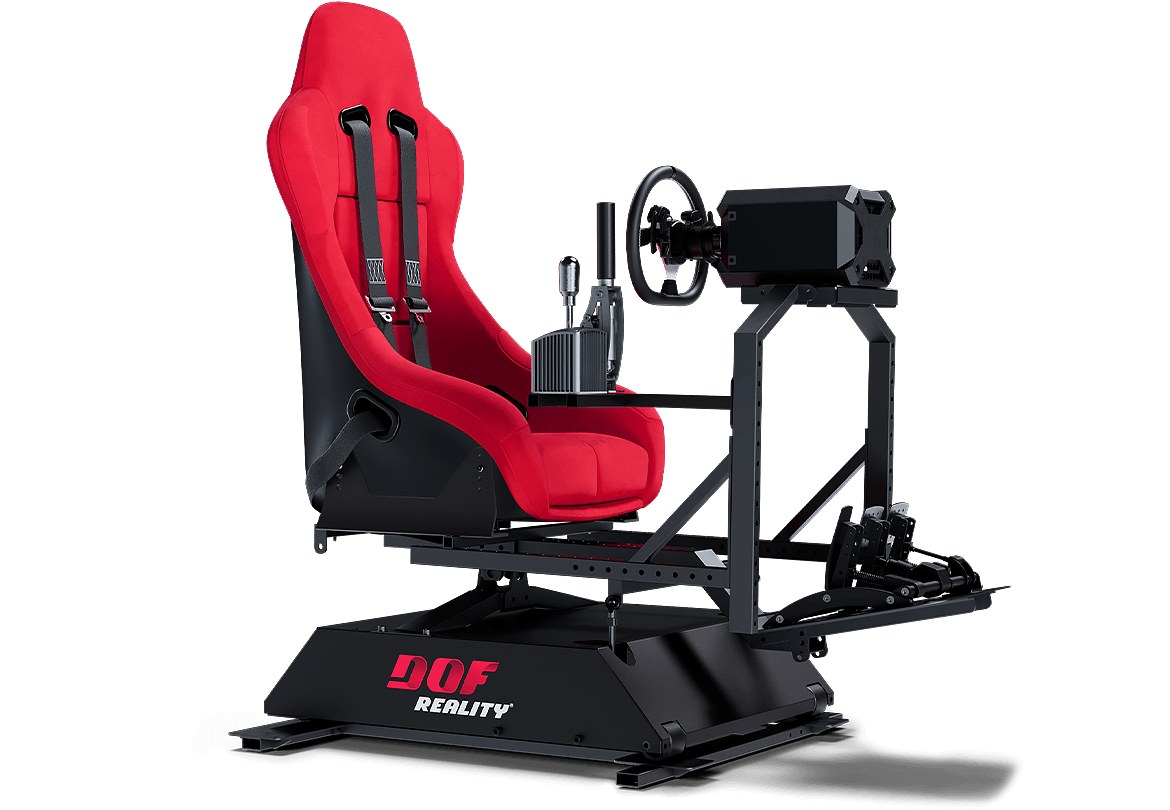
DOF Reality H3: the complete motion simulator that moves everything
DOF Reality has been building motion simulators since 2014, and its HERO H3 is the racing model we put right at the top of this list. The big difference from an actuator kit: here you’re buying the complete platform. The steel frame and the wheel, pedal and shifter mounts all move with the seat, just like in a real car.
The H3 works on three axes: pitch, roll and yaw, plus a rear traction loss system on top. You feel the nose dive under braking and the load through corners, but also the rear stepping out when you oversteer or drift, a real bonus for rally. On paper, DOF quotes 20° of travel, a speed of 50 cm/s and a driver weight of up to 150 kg. The frame accommodates both GT and F1 driving positions.
A SimRacingStudio license is included: the software turns in-game telemetry into motion and also handles bumps, vibrations and gear shifts. DOF claims more than 145 compatible games, from racing to flight sims. Console support is more limited: only a handful of titles (Gran Turismo 7, Forza, F1…) send motion data, through the optional Console Link box.
The H3 is listed at $2,999, shipping extra (allow 3 to 4 weeks), and DOF covers the VAT on deliveries within the European Union. So for less than the MOZA HMA150 actuator kit covered further down, you get the platform and its frame. You’ll still need to budget for the seat, wheel and pedals.
One last strength: the range is upgradeable. The H2 (2 axes, $2,499) lets you get started for a bit less, and the H4 ($3,999) adds heave so you feel bumps and kerbs vertically. Upgrade kits let you move from one to the other without buying everything again.
Pros
- Complete platform: frame, wheel and pedal mounts included
- Three axes plus rear traction loss
- SimRacingStudio license included, over 145 games
- Upgradeable to the H4 (heave)
Cons
- Seat, wheel and pedals sold separately
- Shipping extra, 3 to 4 week lead time
- Only a few compatible games on console
DOF Reality M2: budget motion for your current cockpit
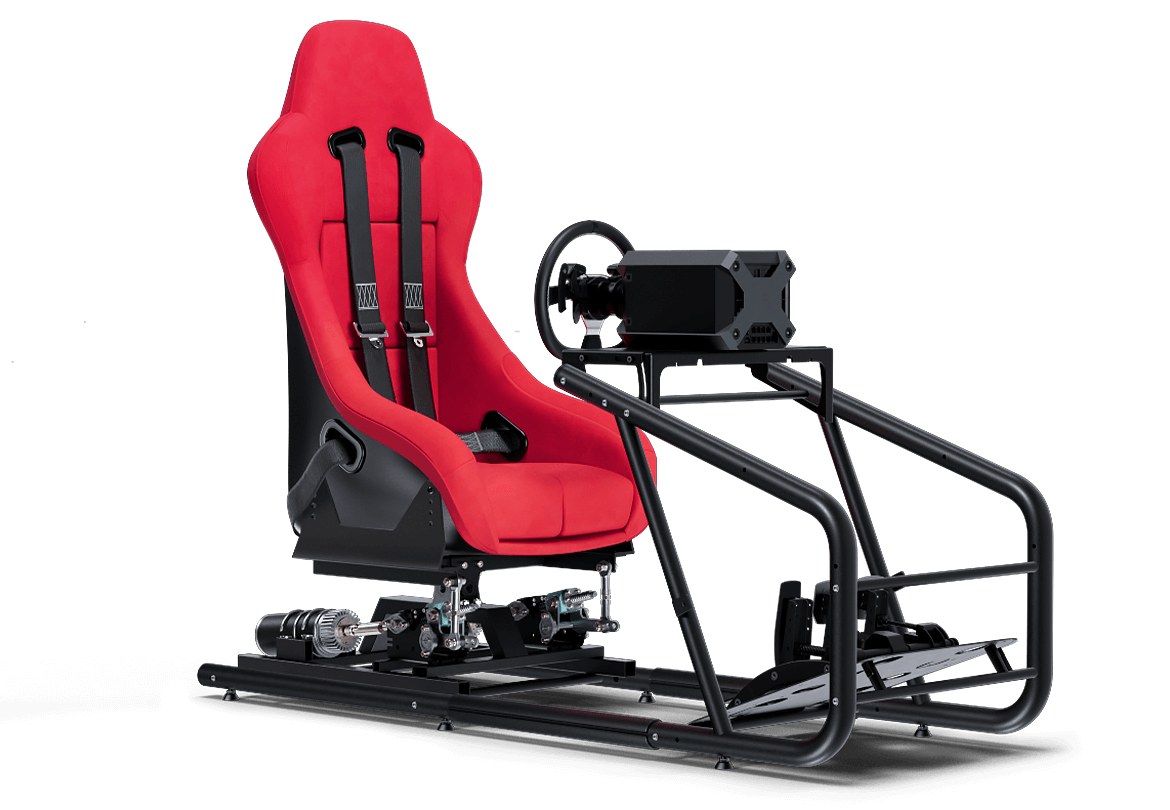
Already have a cockpit and want a taste of motion without replacing everything? The MOVER M2 is the entry-level model from DOF Reality. It slides under the seat of your existing rig (Playseat Evo, Next Level Racing GT Ultimate, GT Omega ART or an aluminum profile rig) and moves it on two axes: pitch and roll.
You feel acceleration, braking and cornering forces. The unit stays very compact (19 cm tall with a 32 x 42 cm footprint), and it ships with its USB controller and a SimRacingStudio license, just like the H3.
At $1,499, it’s the most affordable way into the DOF Reality range. The trade-off: only the seat moves, while the wheel and pedals stay fixed, so the immersion is less complete than with the H3. DOF says so itself: if you’re starting from scratch, a new rig plus the M2 costs almost as much as the H2, which moves the entire platform.
Pros
- The entry ticket to the DOF Reality range
- Fits onto your existing cockpit
- Very compact
- SimRacingStudio license included
Cons
- Only the seat moves, not the wheel or pedals
- Just two axes
- Shipping extra
MOZA HMA150: the motion system that changes the game
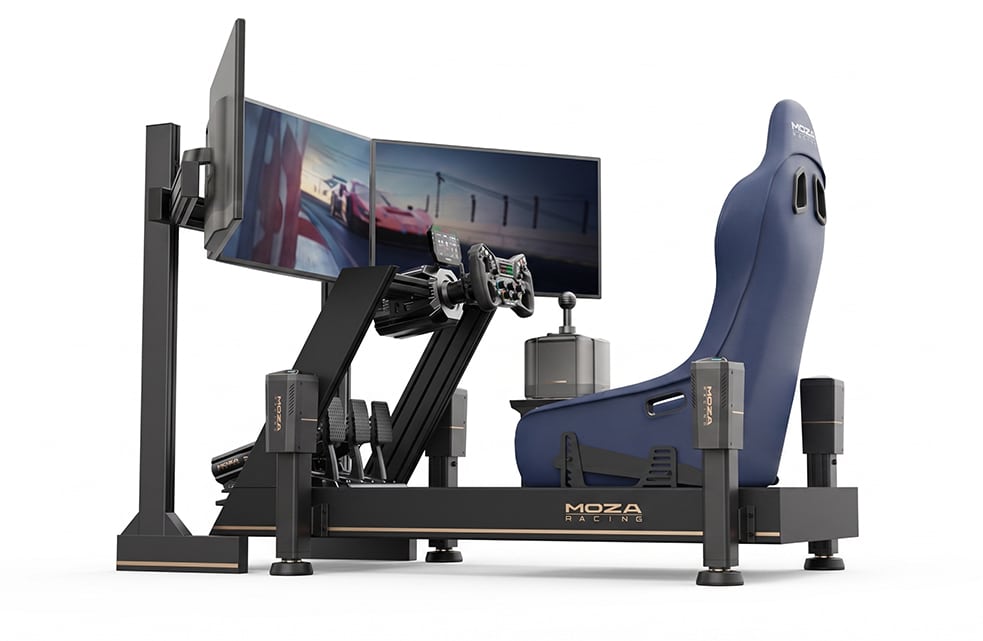
The MOZA HMA150 Haptic Motion System is the brand’s first complete motion system, and it’s the release getting the most buzz on the market right now. In practical terms, it’s four actuators that you install under your cockpit to move your whole driving setup.
These four actuators reproduce motion on three axes: pitch, roll and heave. You feel the nose dive under braking, the weight transfer through corners, the kerbs and the imperfections in the road surface. On paper, MOZA quotes 150 mm of stroke, speeds of up to 300 mm/s, more than 1G of acceleration and a load capacity of up to 350 kg.
Good news on the practical side: the controller is built in (no more bulky separate box), with an emergency stop and a controlled descent for safety. Everything is managed from MOZA Motion Manager, with ready-to-use presets and per-axis tuning.
MOZA also adds its AI Motion: the software analyzes the game’s picture and sound to generate motion even when a title doesn’t output telemetry. It’s promising and still needs to prove itself in real use, but the idea of bringing motion to more games is a clever one.
The HMA150 is listed at €3,199 for the set of four actuators. This is still high-end territory, not motion for the masses. But if you want the best feel available today, it’s a benchmark worth a very close look. One thing to keep in mind: the HMA150 is the actuators, not the cockpit (more on that just below).
Pros
- True 3-axis motion (pitch, roll, heave)
- Built-in controller and safety features (emergency stop, controlled descent)
- AI Motion: motion even without telemetry
- The MOZA ecosystem (wheels, pedals, software)
Cons
- High-end price (€3,199)
- Cockpit not included, budget for it separately
- AI Motion still unproven in real use
What about the cockpit? We recommend Sim-Lab
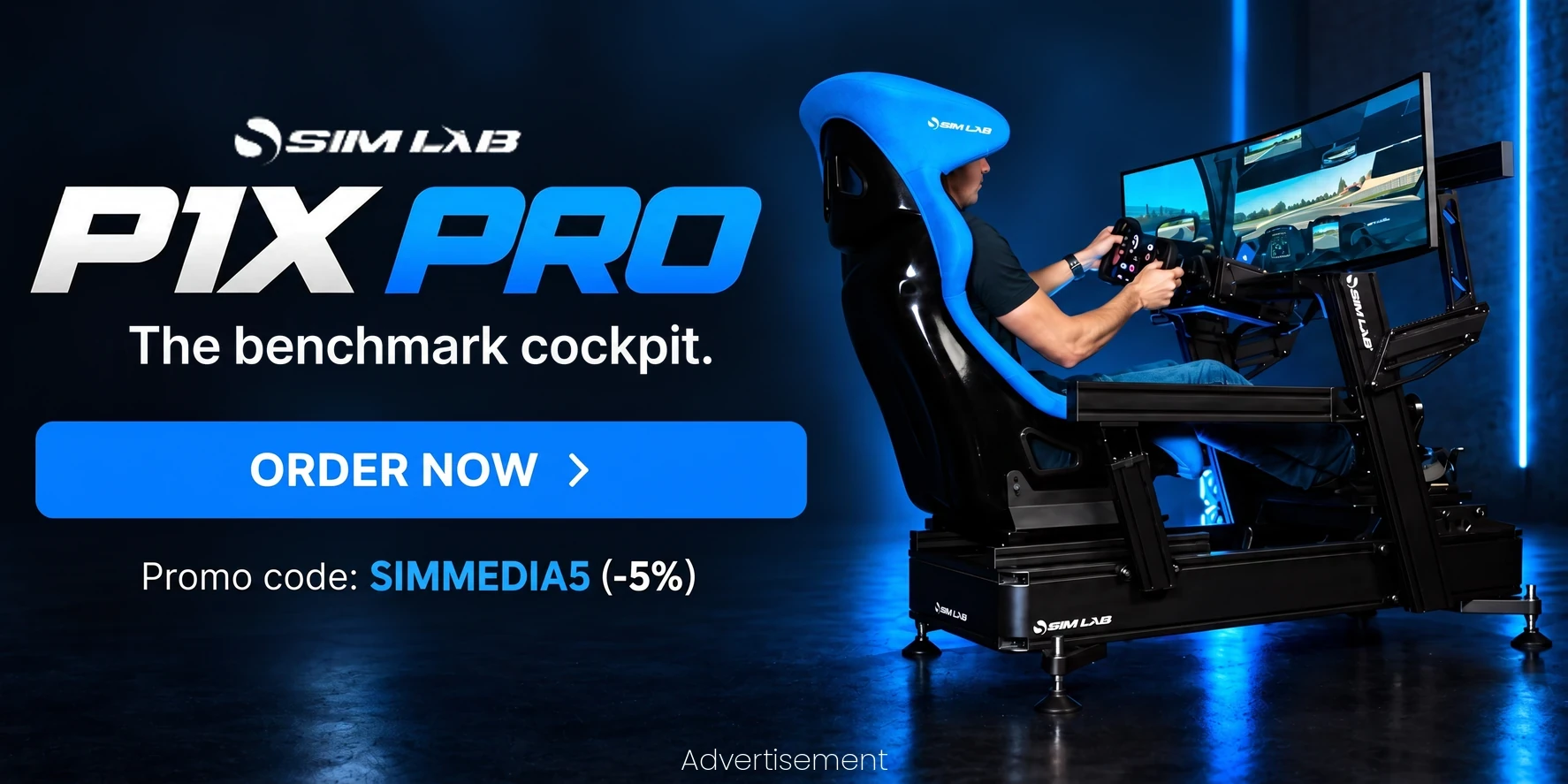
Since the HMA150 sits under a cockpit, you need a sturdy rig on top of it, one that can handle the motion without flexing. Our pick: Sim-Lab aluminum profile cockpits, a safe bet for rigidity. The GT1 Evo (starting at €402) to get started, the P1X Pro if you’re aiming for the very top end. And with the code SIMMEDIA5, you get 5% off everything on sim-lab.eu.
Prosimu T1000: the go-to turnkey motion simulator

Available in 2, 3, 5 and even 7 motion (actuator) versions, Prosimu motion simulators remain a safe bet for a turnkey motion simulator.
Picture yourself in a racing driver’s seat on track, feeling every corner and every burst of acceleration with striking realism. With Prosimu simulators, you’ll feel how your car and the road react, as if you were really out on a track.
The 2 motion version already delivers incredible realism. With this version, you’ll feel every corner and every braking zone in an incredibly realistic way.
If you’re willing to spend a little more, the higher-end versions give you an even more immersive experience. You’ll feel every bit of oversteer, every loss of traction, every ounce of grip and every weight transfer of your car. A real treat for driving enthusiasts!
Prosimu simulators are compatible with more than 100 games, including of course the most popular titles in sim racing (Assetto Corsa, iRacing, Automobilista, Forza, Rfactor, etc.). On top of that, they come pre-configured and plug and play, so you can start driving straight out of the box.
Built with top-quality materials, they’re designed to give you an unforgettable sim experience, day after day. With their reinforced metal structure, you’ll feel every movement with incredible precision, without any distortion or loss of fidelity.
The ProSimu T1000 motion simulator offers excellent driving comfort thanks to its adjustable, tilting pedal mount for an optimal driving position. The wheel mount is pre-drilled with adjustable arms for compatibility with most wheels on the market. And for an even more immersive driving experience, you can also add an optional shifter / HOTAS mount.
A Prosimu rig is the promise of ultra-realistic simulation that puts you right in the heart of the action. So, ready for a one-of-a-kind experience?
Pros
- Unmatched sense of realism
- Sturdy metal frame
- Perfect comfort and ergonomics
Cons
- High price
Next Level Racing Motion Plus: modular motion for your cockpit
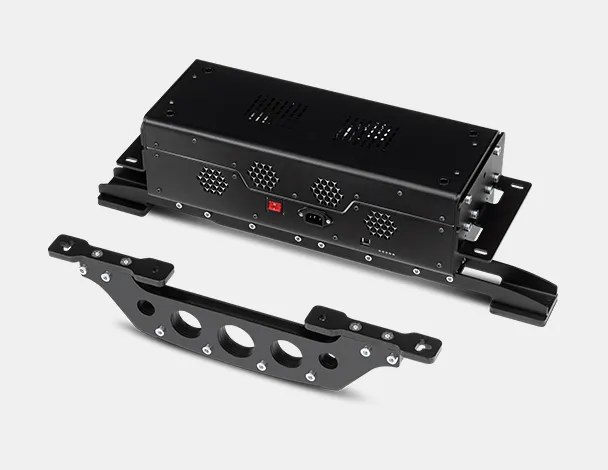
Next Level Racing has been making motion platforms for years, and the Motion Plus Platform is its most modern solution. Like the MOZA HMA150, it’s not a cockpit: it’s a set of motorized units that you mount under your rig to make it move.
Its strength is that it’s modular. A single unit already gives you two degrees of freedom. With two units, you step up to three axes: pitch, roll and heave, so you feel bumps, braking, acceleration and gear shifts. You can even combine it with the brand’s other platforms (Motion Platform V3, Traction Plus) to go up to four axes.
Everything is controlled with Next Level Racing’s Platform Manager software, which supports the main racing and flight games on PC and gets regular updates. A plus for virtual reality: the VR Headway feature compensates for the platform’s movement in the headset to reduce motion sickness.
Price-wise, expect €2,499 per unit on the official store. So be aware: for true three-axis motion you need two, which comes to nearly €5,000, cockpit not included. It’s an interesting option if you already drive in a Next Level Racing cockpit or want to build up your setup in stages.
Pros
- Modular: from two to three axes, up to four when combined
- Pitch, roll and heave with two units
- Regularly updated Platform Manager software
- Built-in VR compensation (VR Headway)
Cons
- Two units needed for three axes (nearly €5,000)
- Cockpit not included
- Designed primarily for PC
FAQ: common questions about actuator motion simulators
What is an actuator motion simulator?
A motion simulator is a robotic platform that recreates a realistic driving experience in a virtual vehicle. Many of these systems exist for entertainment or professional purposes. Either way, this equipment needs an advanced computer system to replicate the movements of driving.
A motion simulator is a platform that includes various accessories and devices, in the form of a gaming cockpit in which the racing seat is installed. On some models, you can also add your monitor, your console, your wheelbase, your pedals and anything else you need to round out your gaming experience. Put simply, it generates tilting, jolts, vibrations, bumps, braking forces… It recreates all the sensations you would feel in a real car or a real vehicle.
What types of simulators are there?
There are many types of simulators: ones that teach you to drive and ones designed for sim racing, for flight training, for driving trucks or trains…
But when we talk about a motion simulator (with movement), we mean two types:
Motion simulators with a cockpit: These are the products that aim to give you an “all-in-one” package. You get not only the platform that produces the tilting, but also the frame that carries the whole gaming cockpit. It comes fully assembled and integrated for your wheelbase, your pedals and your monitors.
Motion simulators without a cockpit: These are standalone models. They include only the motion base, which you place on the floor and integrate with everything else. This option is ideal for drivers who prefer to kit out their own space, without having to adapt to the dimensions of a cockpit, and who want to customize every aspect of their sim racing setup. These models are generally cheaper.
How do you choose a motion simulator?
Here are a few tips to keep in mind before buying a motion simulator:
- Before buying, always keep mounting compatibility in mind.
- Watch out for accessories. You’ll need at least pedals or shifters in a basic cockpit.
- Never buy a motion simulator on price alone. It may not live up to your expectations.
- Check how the motors perform. Make sure they’re as fast and precise as you want.
- Take user reviews into account. They help you figure out whether it will meet your needs.
- Check the maximum supported weight. It has to handle not only your body but also the weight of the seat.
The Bottom Line
The truth is, you don’t absolutely need a motion simulator for sim racing, and you can play your favorite games with a basic setup. But if you want a fully immersive experience, you’ll need one!
We hope our article and tips help you work out which motion simulator best suits your needs. If you’re still on the fence, the 5 models we’ve picked for you here are all safe bets.
DOF Reality H3
The best motion simulator in 2026

0 Comments