
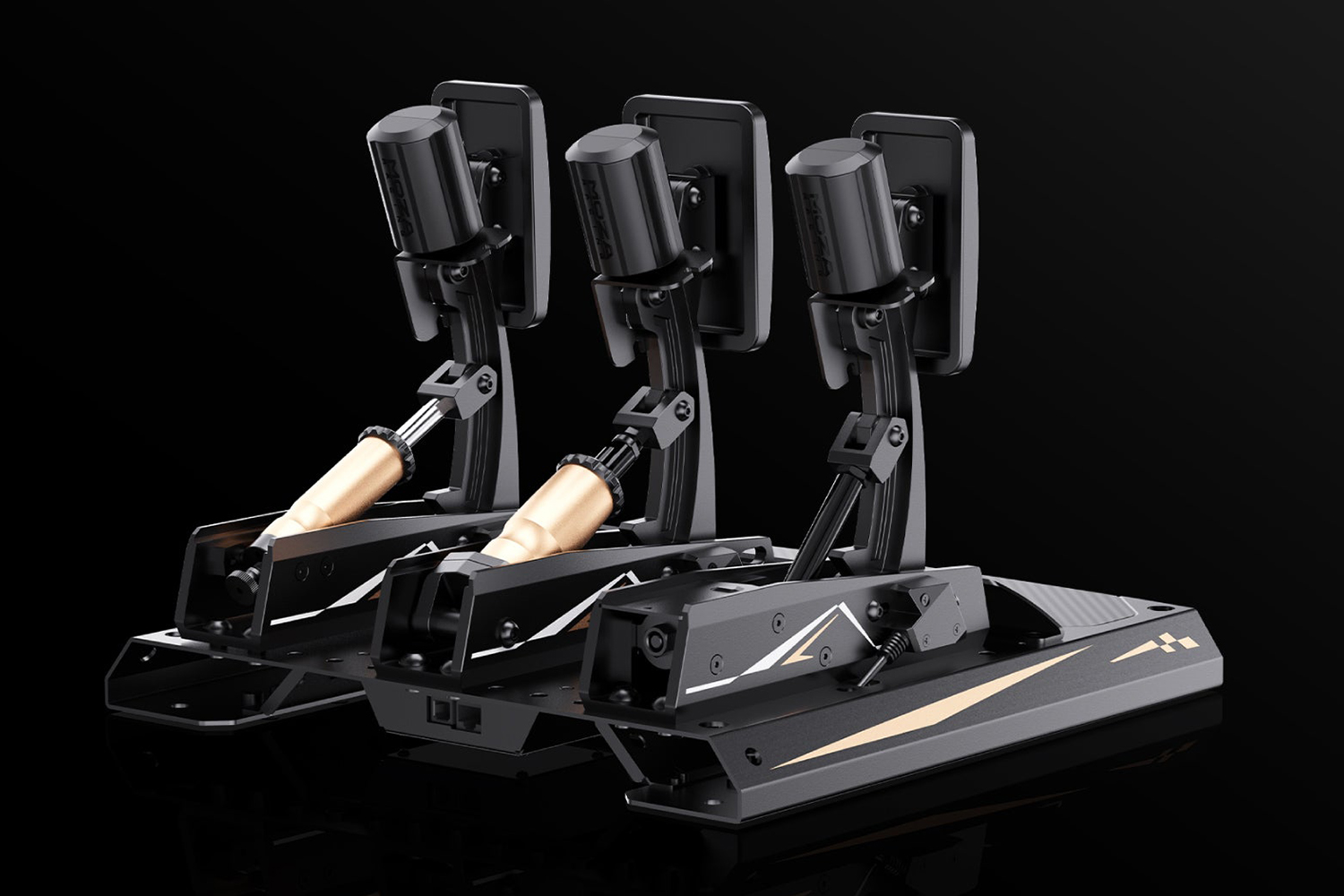

MOZA took advantage of Gamescom to launch the PHF, its haptic feedback module for pedals. The idea is simple: a small vibrating motor attached to a pedal lets you feel ABS, wheel lockup, loss of traction, or gear shifts. It adds feedback to a pedal set that otherwise lacks it, without requiring much more expensive active pedals. The starter kit is priced at €45. At that price, it’s worth asking: is it worth it?
What It Really Is
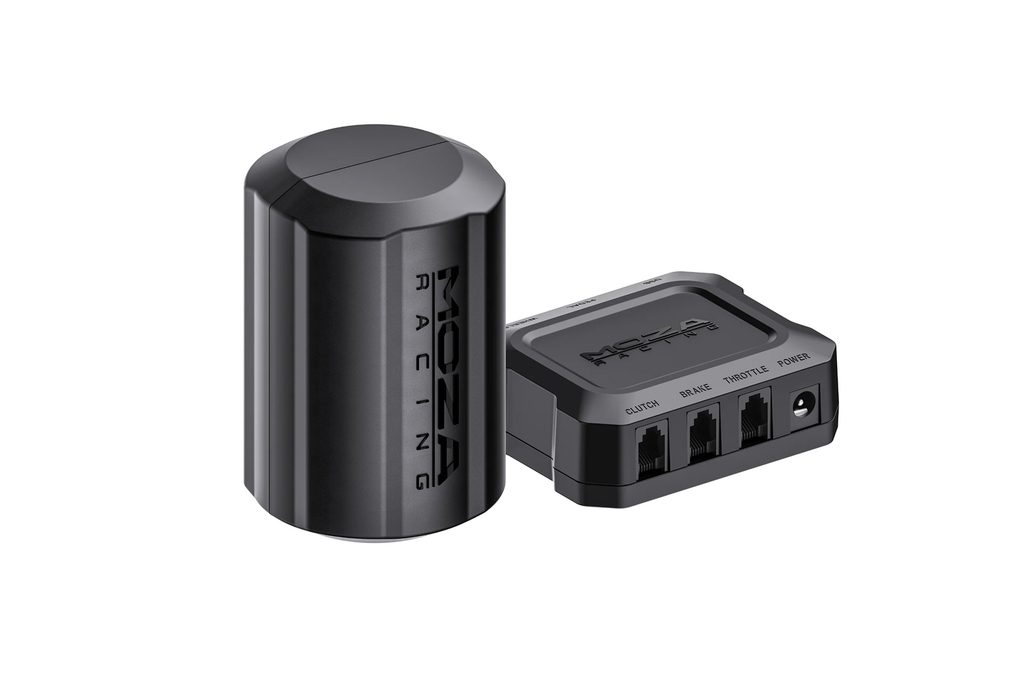
The PHF is a vibration motor housed in a small, compact, and lightweight plastic case that comes with a mounting bracket. The €45 starter kit includes a module and the control unit needed for operation. Inside the box, you’ll find the module, the control box, the mounting bracket, the power supply, the cables (USB and RJ), and the hardware, everything you need to set up your first pedal without buying anything else. To cover all three pedals, you can add modules for €23 each, without having to replace the entire setup.
In terms of compatibility, MOZA targets its non-active pedal sets: SR-P, SR-P Lite, SRP2, SRP Lite2, and CRP2. The unit connects to a PC via USB or to a MOZA wheel base. One important point, however: the PHF only works on a PC via the Pit House software, not on a console. Pedal sets from other brands can also use it on a PC, provided you modify the mount yourself.

The module controls a series of telemetry-driven effects: ABS, traction control, engine RPM, wheel lock, loss of traction, and gear shifts. Everything is configured in the Pit House software, with the frequency (0 to 100 Hz) and intensity (0 to 100%) adjustable for each individual effect. MOZA claims its motor can reach 100 Hz, whereas many similar solutions are limited to 50 Hz.
Each effect is configured pedal by pedal. Engine speed or gear shifts can cause vibrations in all three pedals at once, while ABS and wheel lock remain, as expected, on the brake, where they make sense.
Pedal feel
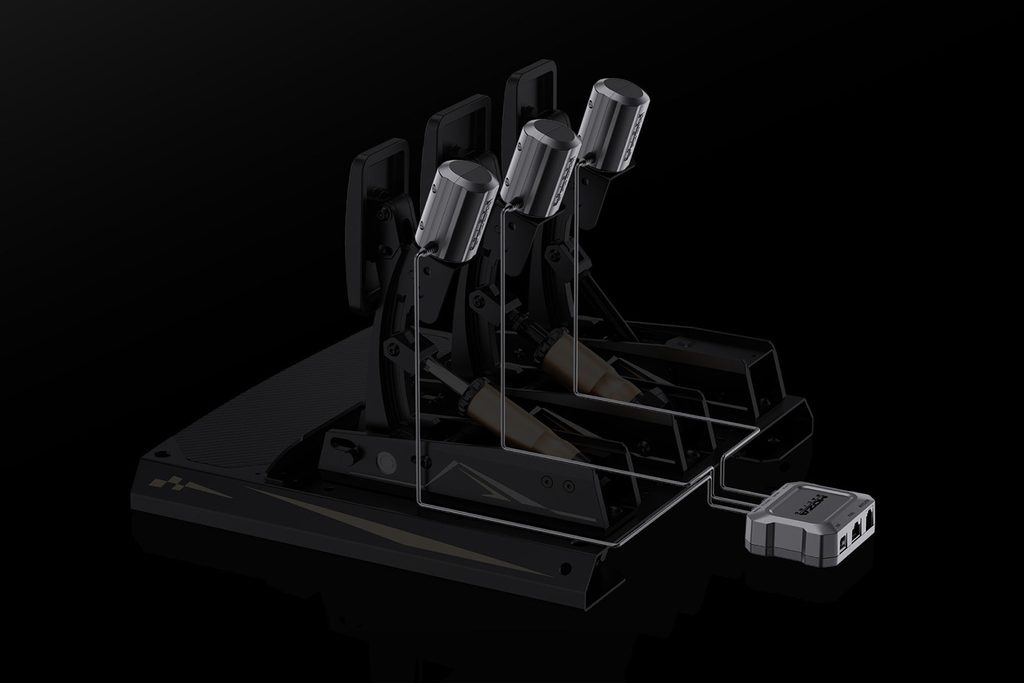
In practical terms, the PHF transmits the information sent by the game to the pedal. When the ABS kicks in, the brake pedal begins to vibrate to signal that you’re approaching the braking limit. One feature is particularly clever: the braking threshold. You set a point in the pedal’s travel where the vibration triggers, and it quickly becomes a reference point for modulating your brake pressure. The same principle applies to the accelerator, where the traction control system vibrates when the wheels lose traction. The vibrations are strong enough to be felt even through shoes, and the response is quick.
The Pit House software is straightforward, and installation is quick: the mount attaches behind the pedal using the original screws, and the whole setup is unobtrusive once installed. One tip, though: by default, the intensity is too high, and all the pedals vibrate at once. It’s best to turn it down and keep only the effects you need, otherwise you won’t be able to tell them apart.
A couple of minor points, too. Depending on the frequency and intensity, the motors make a bit of noise, so you’ll want to turn them down for late-night sessions. And there’s no built-in cable management, although the cables stay securely in place once installed.

So, is it worth it?
It depends on where you’re starting from. If you’re playing on a PC with a basic or mid-range non-active pedal set and want to take your immersion to the next level at an affordable price, the PHF is designed exactly for that. At €45, it’s a bargain for what it adds to a basic pedal set, and installation takes just a few minutes.
The smartest approach is to start with a single module on the brake pedal, where the effect is most noticeable, and then expand if you feel like it. On the other hand, bass shakers remain an alternative, though they’re a bit more expensive, and they make the entire rig vibrate rather than just the pedal.
That said, if you’re already using active pedals, there’s virtually no point: they already perform much better, and are in a different price range. The PHF isn’t for you, and that’s just fine.

0 Comments