

The sim-racing peripherals manufacturer Conspit is just starting out on the market. Like Simagic and Moza, Conspit offers a complete range of sim-racing peripherals, including steering wheels, pedalboards, accessories, a handbrake, a dashboard and DD bases, and even complete rigs. Conspit hasn’t really reinvented the Direct Drive wheel, but has drawn inspiration from other manufacturers to offer a homogeneous, comprehensive range that appeals to amateurs, seasoned riders and professionals alike.
Conspit’s DD bases are called “Ares”, and range from 8 nm to 20 nm torque, with good performance and a complete ecosystem. In what follows, we take a closer look at these bases.
The 8 nm Ares
Design
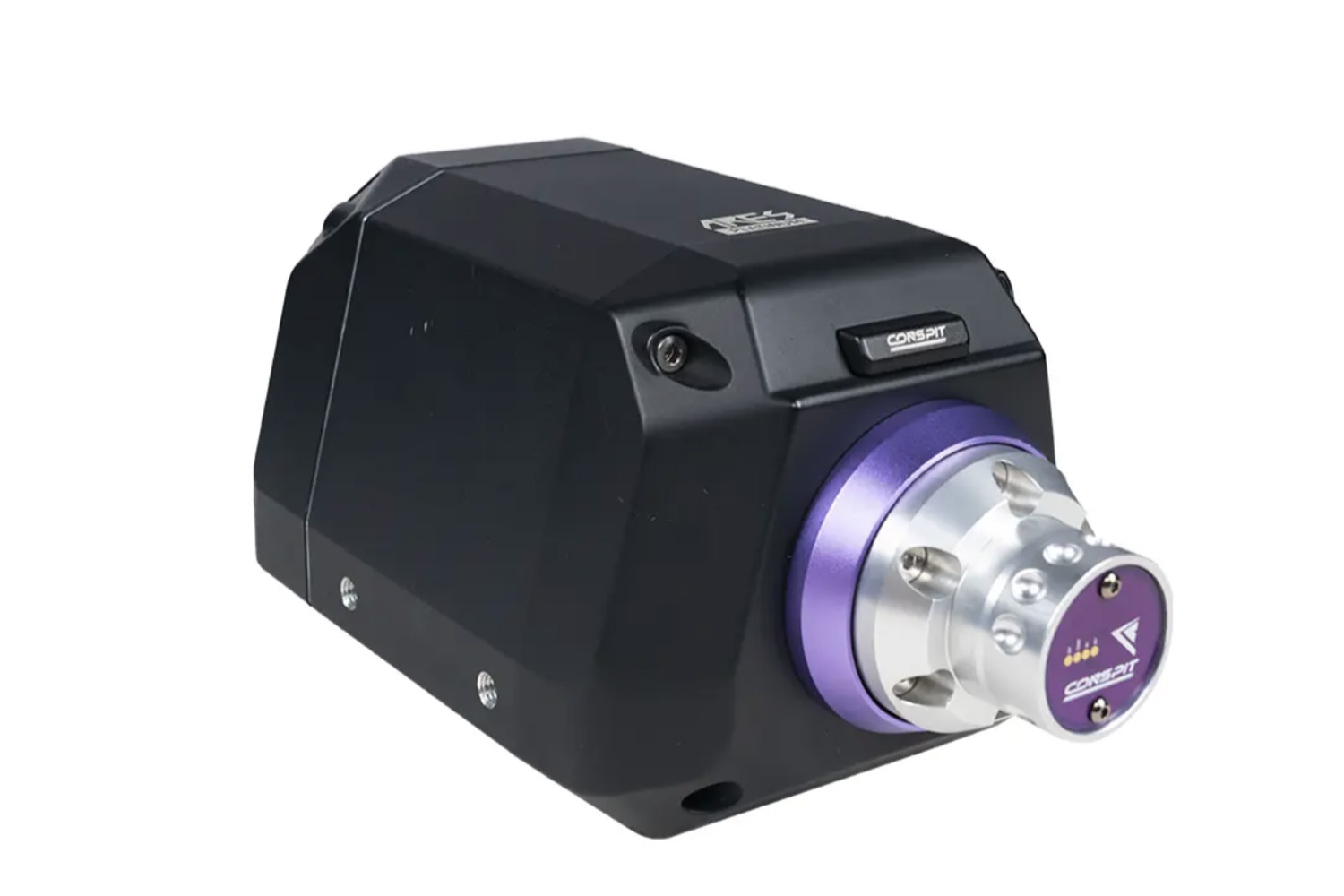
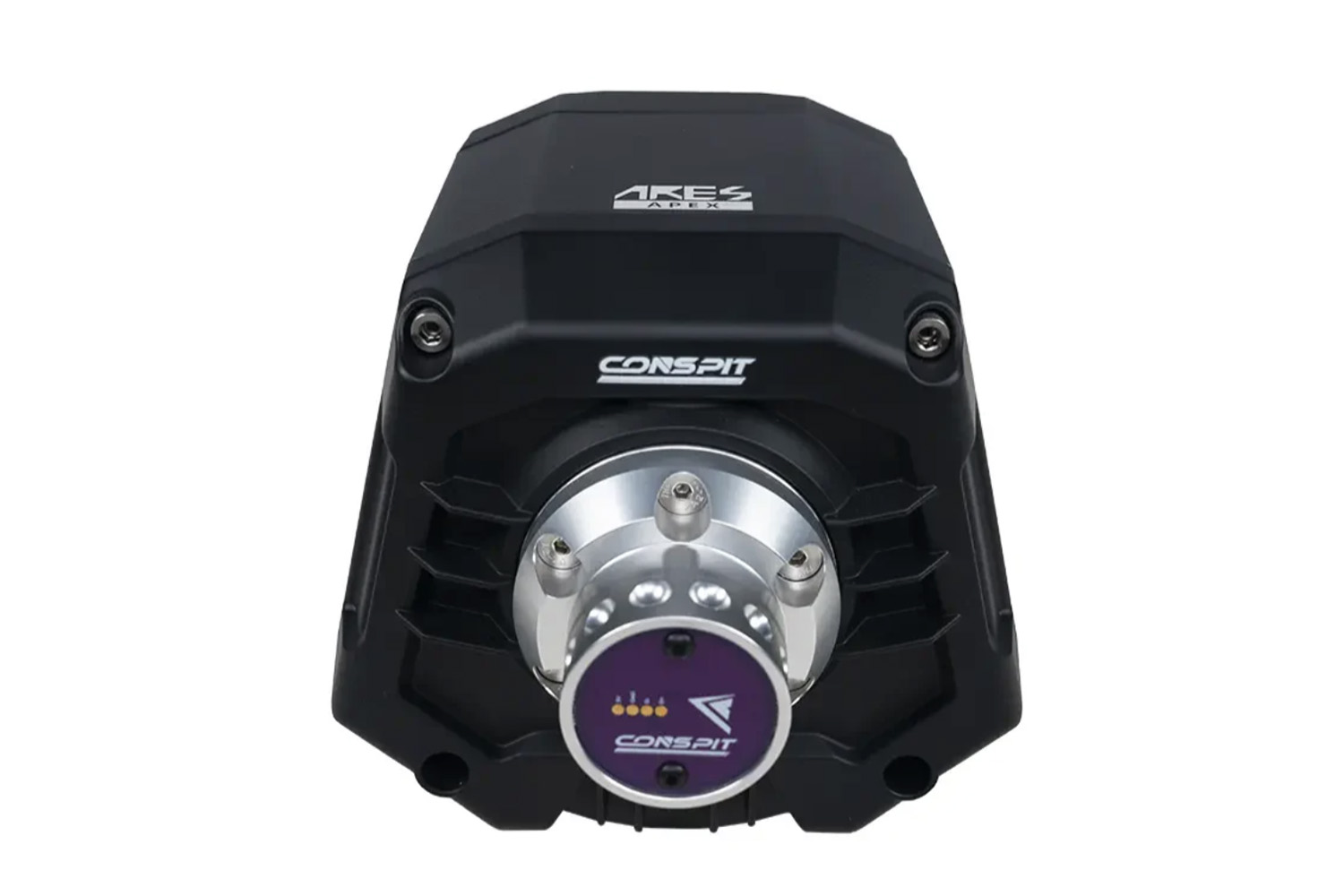
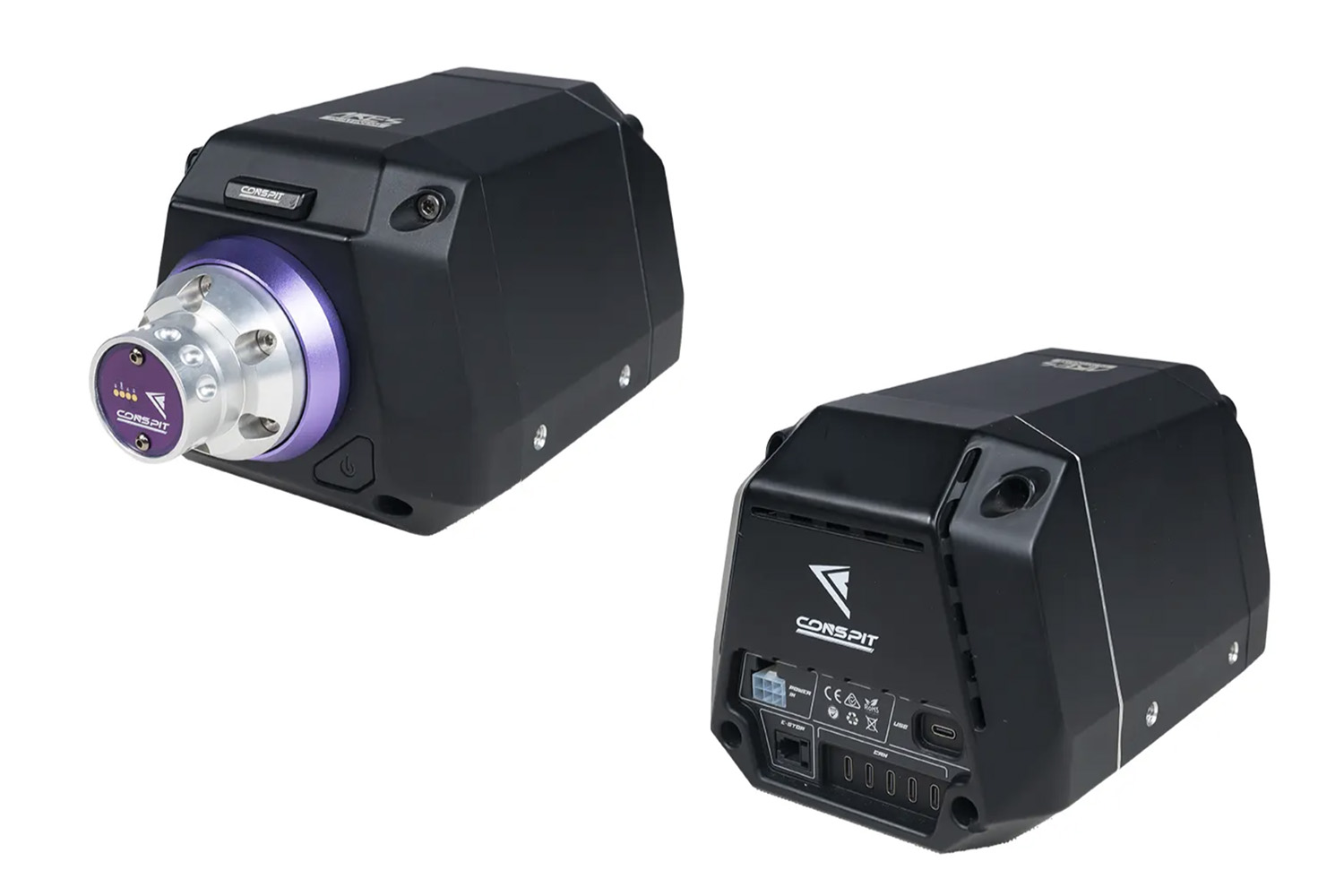
Conspit’s Ares bases bear a slight resemblance to the Moza Racing bases, especially for the Ares 8 nm. It’s a very simple, rectangular shape, with an all-black housing and silver driveshaft.
At the back are all the base’s connections, which are USB-C, so you can connect numerous peripherals to it and interface them on a single USB cable to the PC. It’s a minimalist design, with the logo at the top of the base and that’s it.
Manufacturing quality
The housing is made entirely of aluminum from the aerospace industry, as is the case with Moza Racing products. I guess it’s easier to source this metal and machine it locally than to do it in another country, which keeps production costs down, allows us to offer a quality device and sell it at a lower price. It’s a win-win situation all round.
As for build quality, it’s on a par with the competition, including Moza, Simagic and Fanatec. It’s well-made, with good attention to detail and a finish worthy of a Volkswagen.
The Ares 8 nm is a beautiful, well-built base that doesn’t come with a cheap price tag, having made concessions on quality.
Sensations
The base produces a maximum torque of 8 nm, and it’s not constant. From memory, few manufacturers offer DD bases with constant torque, and in the sub-10 nm range, there aren’t many anyway.
As for feedback, well, it all depends on the title and the competition you’re racing in. On GT races (GT3, GT2), the base is very communicative, with a good dose of granularity. The engine responds very well to feedback, coming out with fine, heavy detail, and letting you get a good feel for what the front wheels, and the car too, are experiencing in terms of force.
But if you switch to a rally title, for example, where a lot of data is transmitted to the driver, you’ll need to set aside some time to find the right settings. I should point out that in doing so, you may have to increase the power of the latter, thus losing granularity and opening the door to saturation.
Nevertheless, I’d like to say that I really enjoyed the hours I spent with the 8 nm Ares, and I think the brand has a good entry-level base. Improvements are easy to make via software when the electric motor is efficient.
Value for money
With a max 8nm DD base, 21-bit encoder, full aluminum structure and 5 USB-C sockets on the rear, you’re thinking that maybe the Ares is priced high. Spoiler alert: that’s not the case.
Priced at around €400, it offers superb value for money. And if you take the Apex bundle bundle, which includes the base, a steering wheel and a pedalboard, it’s a must-have for a good start in sim-racing.
The 12 nm Ares
Design
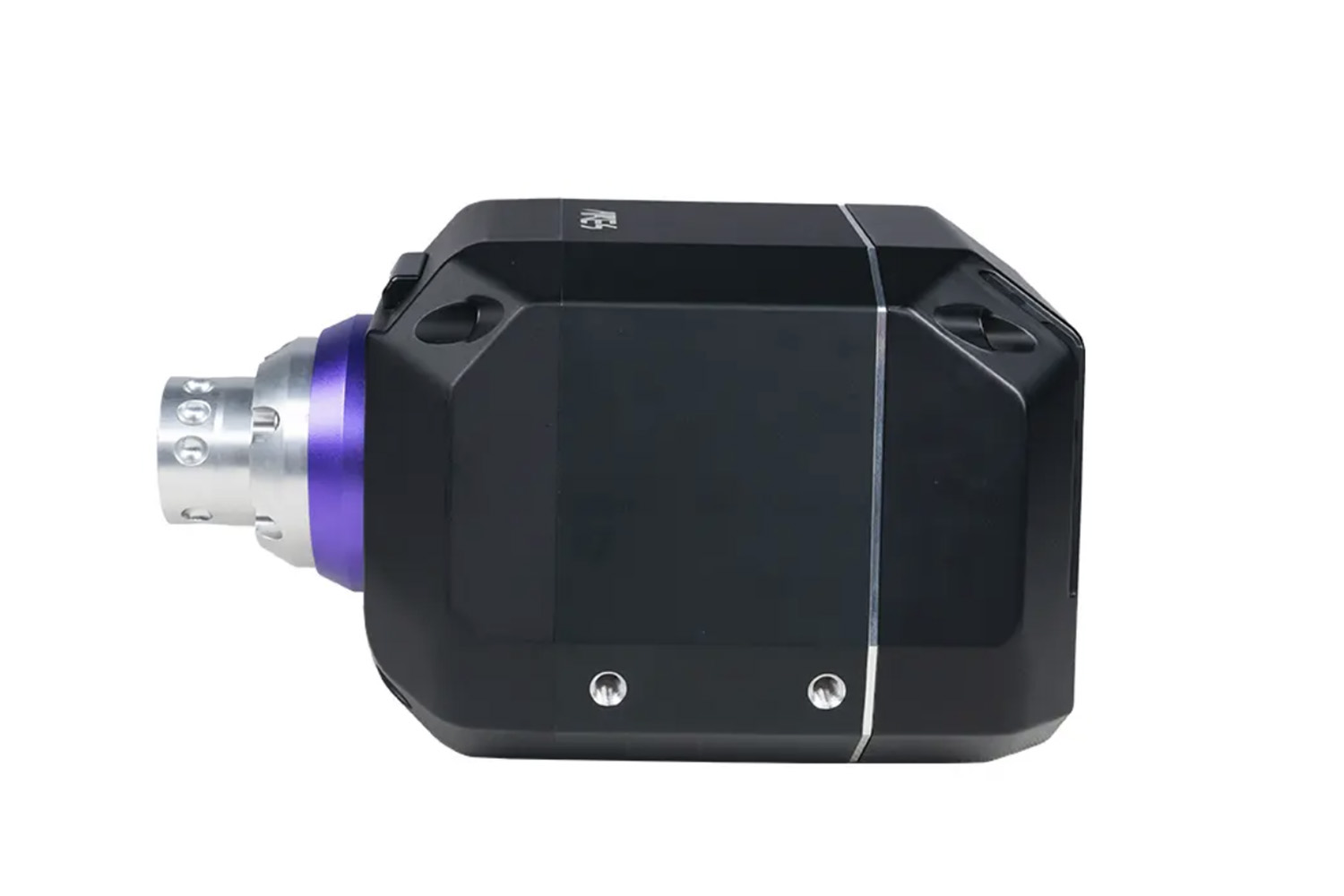
As Moza Racing, Simagic and Simucube have already done, the design of the 12 nm Ares is almost identical to that of the 8 nm, with the only exceptions being its size and a purple band around the drive shaft. The mid-range base is about 7.5 cm longer, and heavier too, as it incorporates a more powerful motor.
There are, of course, other design elements that are slightly different between the two bases, but it’s not striking at all. Most noticeable are the different front plates.
Manufacturing quality
Once again, Conspit has used aluminum for the casing of the 12 nm torque Ares, giving it superb build quality. This is not a device aimed at the entry-level sim-racing market, but one that projects itself onto the middle, or even top, of the podium.
Build quality is simply superb on the 12nm Ares, with a finish worthy of products from Simagic and Fanatec. It’s premium, heavy in the hands because of the motor, and well made.
Sensations
The Ares 12 nm has been on the market for some time, which has enabled Conspit to fine-tune the base’s software and firmware. The result: the base is ultra-communicative, projecting light and heavy effects without plugging in. It juggles between small bumps and big shocks without displaying an ounce of clipping when properly configured.
The 23-bit encoder is present on the 12-nm Ares, as is the Ares Platinum, but I’m not sure if it makes any difference on the track, since 21-bit is already standard on the market. Nonetheless, it’s a good enough base to take on ClubSport DD all day long, even if the Ares develops 12 nm of torque at peak, not constant.
Value for money
Where Conspit really comes into its own is in what it offers for €590. At this price, you get an aluminum base, a 23-bit encoder, ultra-communicative sensations and well-polished firmware – it’s a solid package, hard to ignore in this price range. Its value for money is just superb, backed up by sensations that live up to your expectations.
The 20 nm Ares Platinum
Design
Not surprisingly, the Ares Platinum is a carbon copy of the Ares 12nm, only heavier this time. Size doesn’t change, but the motor is about 500g heavier than the mid-range base.
Manufacturing quality
Don’t be fooled into thinking that Conspit is going to skimp on quality materials for its top-of-the-range products. The Ares Platinum is a high-quality, well-made premium base. You won’t find a flaw on this device, be it in materials, assembly or finish.
Sensations
The Ares Platinum develops 20 nm of maximum torque, a hair more than Simagic’sEvo Pro. And just as the Ares 12 nm has matured over the months, the Platinum has done the same, with software and settings that are very precise when racing.
The base is ultra-communicative, pushing saturation well above the Ares 12 nm, although with the latter, when properly configured, you’d be hard-pressed to feel any clipping with it. The 20 nm gives you plenty of headroom on the Platinum, and I love it.
Value for money
At €830, the Ares Platinum is positioned in the same price range as its direct competitors. But where it really comes into its own is power: 20 nm on the counter, compared with 18 nm for Simagic’s Evo Pro and 15 nm for Fanatec’s ClubSport DD+ – for the same price.
In other words, you get more for your money, without even mentioning the 23-bit encoder, which further widens the gap on paper. If you want to test the Conspit ecosystem at the top end of the market, the Ares Platinum is a clear choice.
Conspit Ares
Top-of-the-range at a reasonable price
0 Comments