

In the space of just a few years, Simagic has made a name for itself in sim-racing, offering high-performance peripherals developed by enthusiasts and professional drivers to satisfy the needs of virtual racing enthusiasts.
Until recently, Simagic was mainly targeting racers looking for Direct Drive bases in the mid- to high-end range. This is good for sim-racing enthusiasts, as it allows them to take full advantage of their peripherals. However, it leaves those with less experience in the pits.
The Direct Drive Alpha base range had just 3 entries: theAlpha Mini with 10 nm of torque, the Alpha with 15 nm and the Alpha U with its 23 nm of torque. As a result, Simagic was mainly positioned opposite Moza Racing with its R9, R12 and R21, and Fanatec with its CSL DD (8nm) and the Podium DD and DD2.
However, Fanatec has updated its catalog to include the ClubSport DD and DD+, which develop 12 and 15 nm of torque. Simagic’s response was the Alpha Evo range, and these bases are still available in 3 power levels: 9, 12 and 18 nm of torque. This enables the brand to expand its customer portfolio, and also to compete with many more manufacturers on their circuits.
In what follows, we take a look at Simagic’s 3 new bases and what they’ve got up their sleeves.
The 9 nm Simagic Alpha Evo
Design and features
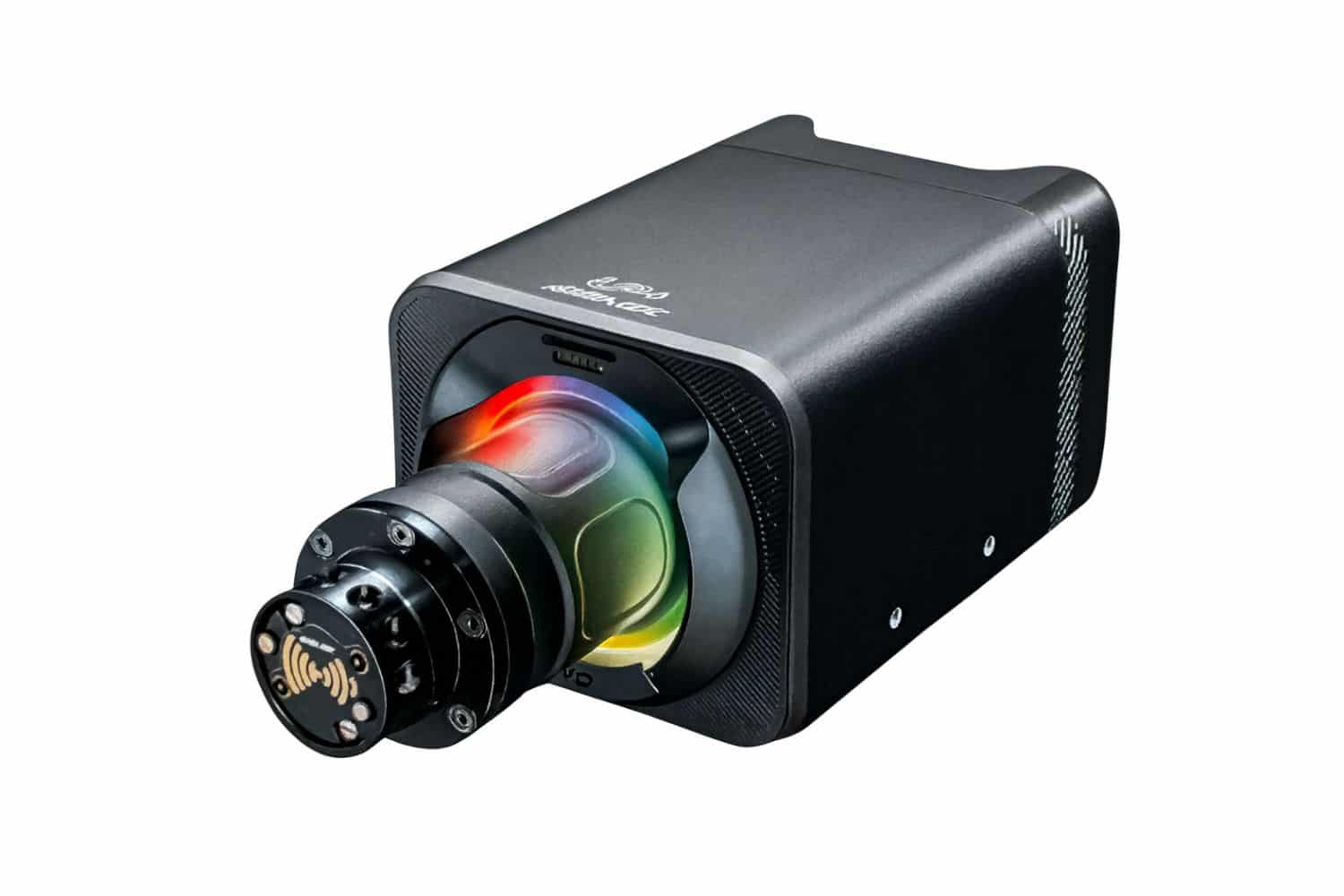
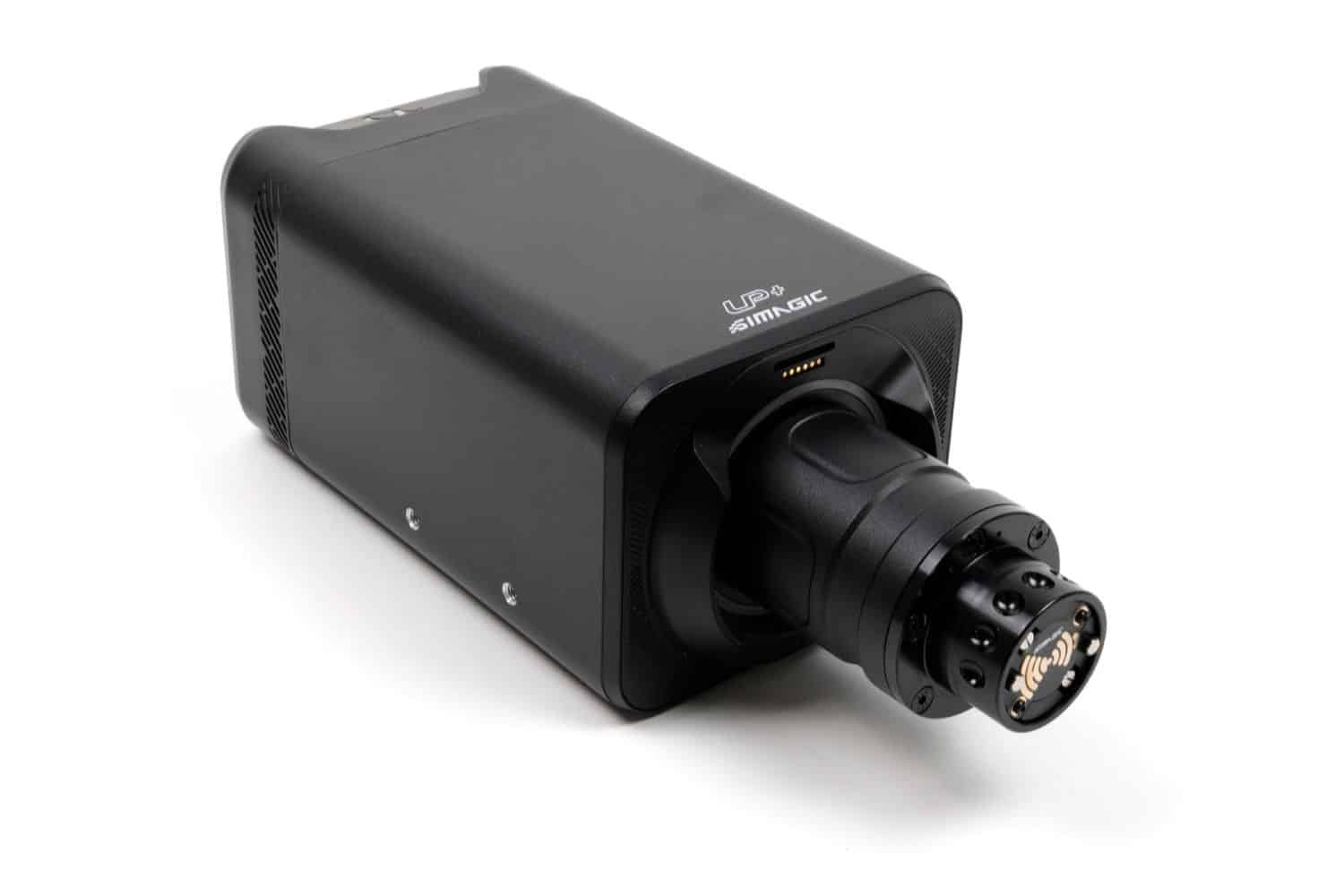
Let’s talk about the design of the 9nm Alpha Evo, the least powerful DD base in Simagic’s offering. Visually, there are no big changes from the Alpha Mini, to be honest: the design becomes simpler as Simagic has swapped square edges for rounded ones this time, and dropped the flat carbon front for RGB.
Well, you know my position on RGB I suppose, and for those who don’t: I’m not a big fan. Fortunately for us on the Alpha Evo, it’s not that noticeable once the steering wheel is installed.
As for the rest of the housing, it’s far more attractive than the Alpha Mini as far as I’m concerned. The multi-element design is still there, but this time it’s less pronounced. The transition from the cabinet to the back plate is not visually abrupt, and I find it gives the base a more elegant look.
Let’s move on to the technical specifications. The smallest version of the Alpha Evo develops 9 nm of torque. The encoder increases from 18 bits to 21 bits, and the engine incorporates “Zero-Cogging” technology for an ultra-realistic sim-racing experience. What’s more, Simagic has strengthened its ecosystem, making it easier for other brands, and therefore other flywheels, to access this base. Usually, brands want to close off their ecosystem so that pilots stay within it and buy everything from a single source. This move by Simagic could potentially be risky for the brand, or quite the opposite, but only time will tell.
Materials and build quality
The materials used on the Alpha Evo are premium, and we wouldn’t expect anything less from Simagic. The cabinet is made entirely of metal, with excellent build quality. It’s well made, well finished, and I think it’s a nice evolution from the Alpha Mini, hence the name “Evo”.
Value for money
The 9 nm Alpha Evo base is priced at almost €480, which puts it well ahead of an 8 nm CSL DD (€450) and a Moza R9 V3 (€400).
When it comes to value for money, I think Simagic comes out on top. The base could be a hair less expensive to compete well with Moza’s R9, because on paper, the two share many elements, such as power, 21-bit encoder, while being the sweet spot of many racers. But Simagic has a secret card up its sleeve, and that’s “Zero-Cogging”, something the R9 V3 doesn’t advance on its technical page. So, as far as I’m concerned, this partly justifies the €80 price difference between the two bases.
The 12 nm Simagic Alpha Evo
Design and features
The Simagic Alpha is already a very similar base, and for the Evo range, the brand hasn’t changed a thing. As a result, the 12 nm Alpha Evo is a carbon copy of the 9 nm Alpha. Same minimalist design that suits it so well, rounded edges that replace the 90° ones of before, and still RGB around the transmission axis.
In terms of technical specifications, the motor now develops 12 nm of maximum torque, with a 21-bit encoder and zero-cogging. To be frank, the Evo 12 nm is just a more muscular version of the 9 nm, just as the ClubSport DD+ is compared to the DD at Fanatec.
Materials and build quality
Of course, the Evo 12 nm is an all-metal case, and so it should be. The materials are of the highest quality, and the workmanship is top-notch. I expected nothing less from Simagic, and I was not disappointed.
The Evo 12 is a beautiful, well-finished base that reflects the brand’s philosophy of offering a quality product at an attractive price.
Value for money
Speaking of monetary exchange, the Evo 12 nm costs €623, and that’s very aggressive as far as I’m concerned, especially against the competition from Fanatec. Well, it’s true that it’s still around €100 more expensive than a Moza R12 V2, but the Evo 12 nm is sold for almost €170 less than a ClubSport DD, which develops the same power on paper. Not in the same way, of course, as the ClubSport DD delivers 12 nm of continuous torque, whereas the Simagic base is in peak.
The 18 nm Simagic Alpha Evo
Design and features
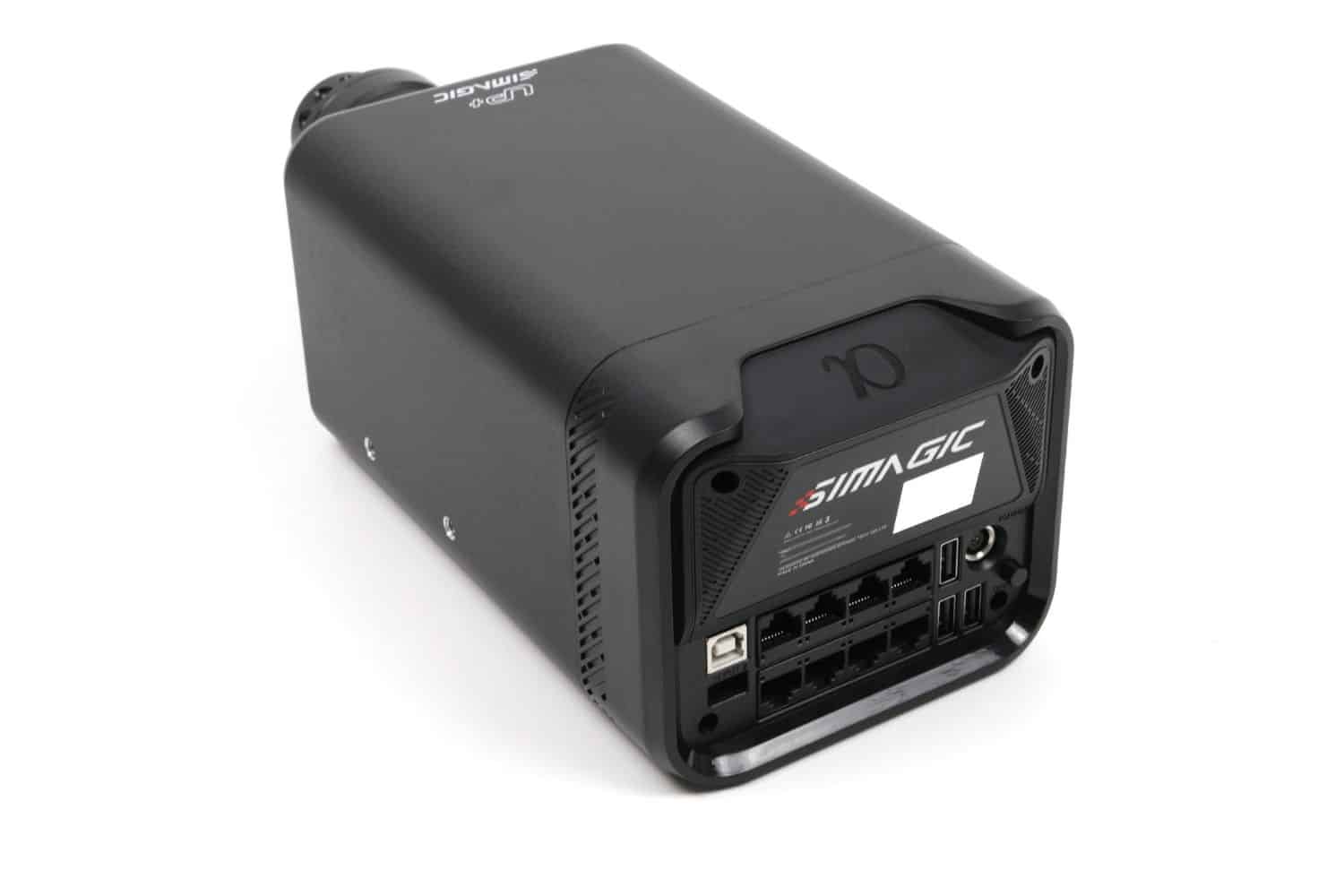
Let’s finish with the 18 nm Alpha Evo. As you’d expect, this base model is visually identical to the other two, in every respect. The only difference lies in the technical aspect of the electric motor inside.
For this top-of-the-range variant of the Evo series, the latest Simagic base develops 18 nm of peak torque, with the 21-bit encoder and Zero-Cogging still present.
Value for money
The Alpha Evo 18nm is a base that isn’t all that expensive if you take into account the brand, technologies and developed power. It currently trades for around €840, which puts it in the ring against bases that are a hair more powerful.
As for Moza, the R21 is also in the €800 range, and is more powerful. As a result, Simagic has intentionally positioned its base against more generous competitors in terms of torque, which could indicate that the 18 nm Alpha Evo is a high performer.
Simagic Alpha Evo
The evolution of Direct Drive
0 Comments