


We finally have a complete view of the Forza Horizon 6 map, confirming the rumors surrounding Japan as the playground. Playground Games has announced its“densest and most vertical map“, and we can immediately see the ambition to offer a driving experience in a territory that invites piloting. The season system remains firmly in place, promising notable variations in grip and visibility.
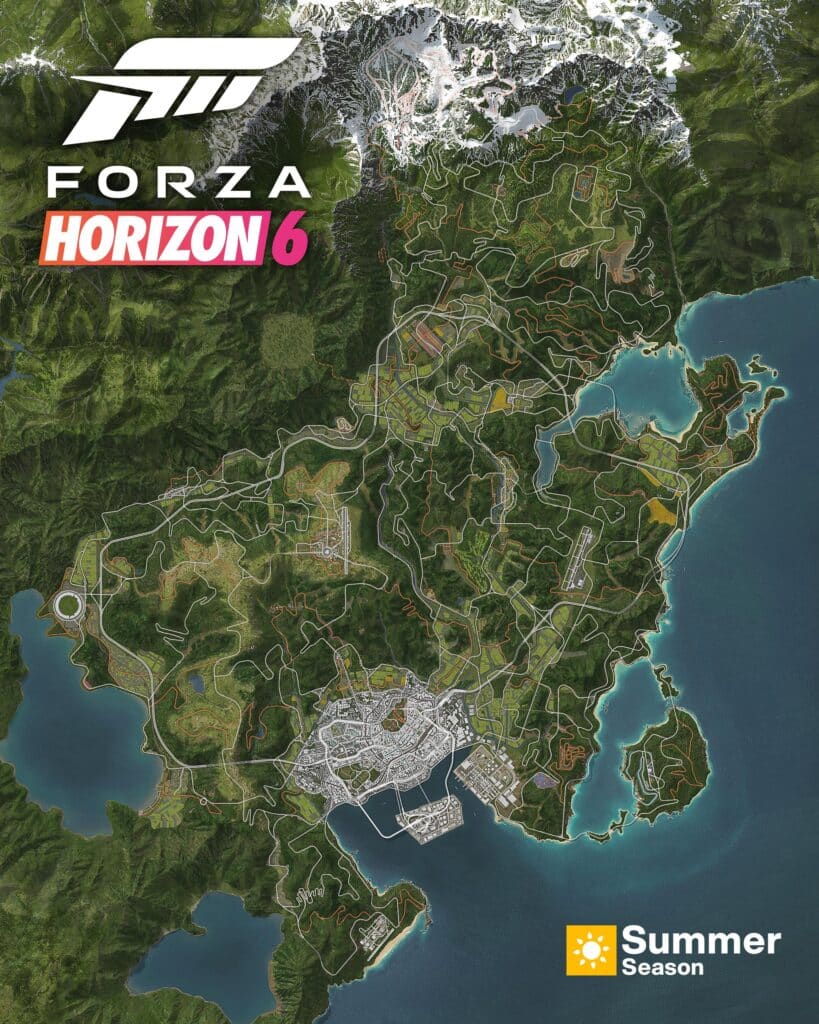
The figures speak for themselves: the surface area is twice that of FH5’s Mexico. But more than the size, it’s the density that catches our attention. With around 660 passable roads, compared with 578 previously, we’re expecting far fewer soulless flat sections. This will enable more varied layouts, more contextual challenges and better integration of events into the environment. We’re hoping for a series of turns that don’t all look the same.
Verticality is clearly the sinews of war. Between Tokyo’s multi-level interchanges, the Highlands and the Japanese Alps, the FFB of our steering wheels is going to be put to the test with changes in gradient. The north of the map is presented as particularly demanding, with snow-covered roads and steep terrain. We’re already anticipating downhill trail-braking sessions, where we’ll have to really break down our braking to avoid ending up on the side of the road.

Tokyo is the piece of choice. The city is a biome unto itself, developed by a dedicated team. It is promised to be“five times larger than previous cities”. This translates into a dense urban center, narrow streets that will force precision in trajectory and anticipation, complemented by industrial zones conducive to improvised drifts. The fast roads on the outskirts of the city and the Shutoko-inspired elevated highways should offer opportunities to ride at more delirious speeds, even if it means saturating the field of vision on a triple screen. The complexity of Tokyo’s stacked infrastructure is likely to call for good anticipation of chord points, especially for blind bends under interchanges.
Beyond the capital, the map is segmented into several regions: Japanese Alps, Highlands, Low Mountains, Plains and Coast. Each zone should offer its own character, with what this implies in terms of choice of car and setup. The Alps, for example, should favor all-wheel drive with good low-end torque, while the plains will allow Vmax to be tested without too many constraints. It remains to be seen whether the promise of density will also be reflected outside the most marked urban areas.




0 Comments